Sany Group’s customized engine fully automated laser marking workstation recently delivered
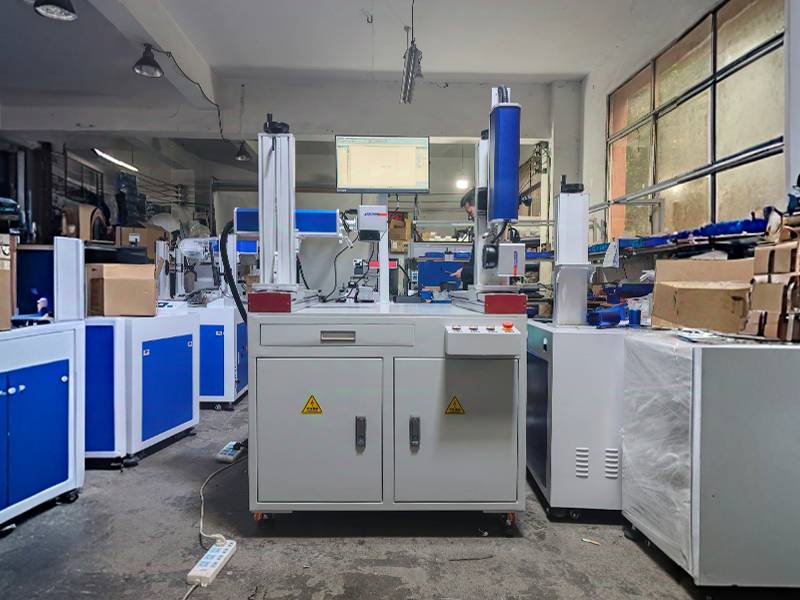
We recently tested and delivered a customized laser marking prototype for an industry. The customer is the Sany Group, a world leader in technology, reputation and size in the construction equipment industry. Due to its high level of automation and financial strength, the customer wanted to mark the top and sides of a cast aluminum engine block in the shortest possible time while using robotic loading and unloading.
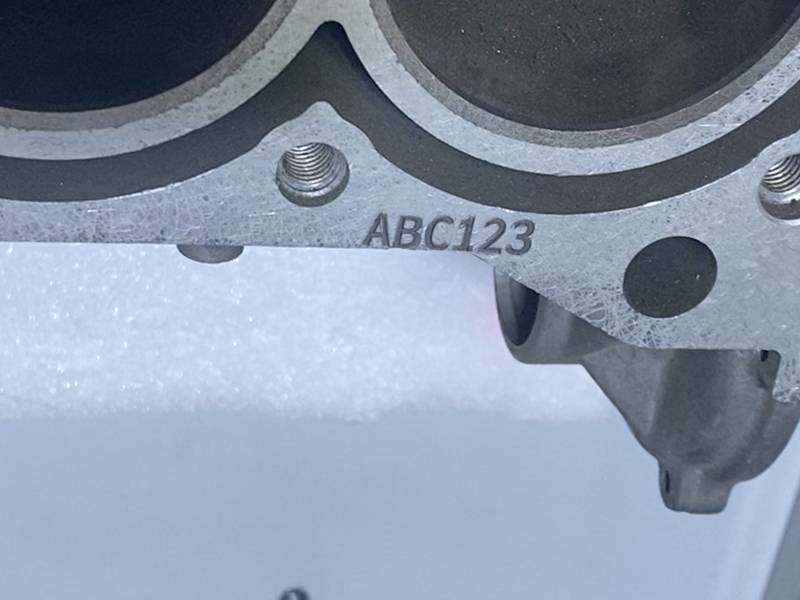
Based on considerations of minimizing handling and adjusting the position and angle of the engine, and after technical and process discussions, the customer ultimately selected a dual-fiber marking workstation that uses two 100W MOPA fiber autofocus lasers to scan for high-contrast, deep marking of the two workspaces, and a high-speed servo motor motion module to clear the robot load/unload workspace by resetting the position. A full marking cycle time of approximately 15 seconds for a single motor has been tested to mark dark gray areas to a depth of approximately 0.2 mm without burning or yellowing.
Reduce any movement of workpieces.
Reduce any adjustment for speed up.
Is it enough?
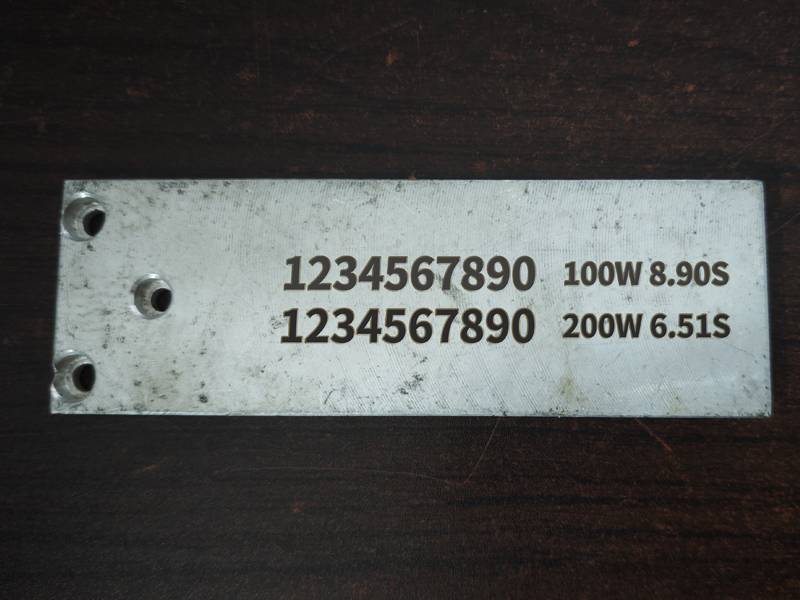
After several times of marking test, the customer finally chooses 100W JPT M7 lasers with 95% power setting for the job. The 200W or more powerful lasers need to set the output around 140~150W, which is marking a little better, but cost much higher for the system.
If you are finding integrated laser solution in line, contact us and ask for a sample marking.
Application Context for Sany Group's customized engine fully automated laser marking workstation recently delivered
This page is part of CNMarking’s Laser cleaning content library. For buyers comparing similar equipment, the key question is not only whether the sample can be marked, cleaned, welded, or processed, but also whether the final setup can match production speed, fixture stability, marking depth, visual quality, and long-term maintenance requirements. The application is most relevant to rust removal, paint stripping, oxide removal, weld mark treatment, mold maintenance, and controlled surface cleaning before production.
When evaluating a similar project, CNMarking normally checks the workpiece material, available marking area, expected cycle time, required code or logo content, fixture method, safety enclosure needs, and whether the process must connect with an existing line, MES, scanner, or operator workflow. These details help choose between a standard machine, a semi-custom workstation, or a fully automated solution.
Recommended CNMarking Product Pages
- Laser Cleaning Machine Category
- Pulsed Fiber Laser Cleaning Machines Guide
- Pulse Fiber Laser Cleaning Machine
Related CNMarking Case Studies and Guides
- 300W Pulsed Laser Cleaning for Semiconductor Reflow Carrier Trays
- Zixu 3000W CW Laser Cleaner Helps SANY Group
- Client Inquiry on Pulsed Laser Cleaning for Paint Removal
How to Choose a Similar Setup
- Send clear photos or drawings of the workpiece, including the required marking or processing position.
- Confirm the material, surface coating, required depth or contrast, and any durability requirements after cleaning, painting, heat treatment, or outdoor use.
- Share the expected production rhythm, such as pieces per hour, operator loading method, fixture constraints, and whether automatic code reading is required.
- For new applications, request sample testing first so the marking quality, processing speed, and fixture plan can be confirmed before mass production.
FAQ
Can CNMarking test my own samples before quotation?
Yes. For most marking, cleaning, welding, and precision laser processing projects, sample testing is the safest way to confirm process feasibility. A short video, test photos, and recommended configuration can be prepared after the workpiece and target result are confirmed.
What information should I send for a faster recommendation?
Please send the material, dimensions, required content, target cycle time, production environment, and any automation requirements. If the project is replacing an existing process, also share the current pain point, such as low efficiency, unstable quality, consumable cost, surface damage, or traceability requirements.
Need a similar solution? Contact CNMarking with your workpiece photos and target result. Our engineers can recommend a standard model or a customized workstation based on your sample and production requirements.