Gas Cylinder Marking Machine Buyer Guide: Depth, Curves and Traceability
Industrial buyer guide
A gas cylinder marking machine is not chosen the same way as a flat nameplate marker. Cylinder geometry, neck-ring access, required traceability depth, handling risk and repainting exposure all change what a reliable marking process looks like. Buyers who only compare a headline marking window or a generic machine photo usually miss the fixture, stability and inspection details that decide whether the mark survives the real plant workflow.
This guide is written for B2B evaluation. It explains how to prepare a cylinder-marking project, where depth and curved-surface boundaries appear, how to compare handheld and workstation routes, what to check during sample testing, and how to protect uptime, safety and traceability without inventing universal machine parameters.

- Which cylinder surfaces need the code: shell, neck ring, shoulder or painted area?
- How deep must the code remain after handling, coating touch-up or field inspection?
- Does the line need a handheld process, a benchtop station or a supported rotary workflow?
- What inspection rule defines a pass: readability, location consistency, character depth or downstream scanning?
- How much downtime risk can the plant tolerate during fixture changeover, cleaning and operator handoff?
1. Prepare The Right Inputs Before Comparing Machines
A useful quotation request starts with production facts, not only a keyword. For gas-cylinder work, the supplier needs to know what material is being marked, where the content sits on the cylinder, whether the mark must pass repainting or outdoor handling, and how stable the part is during marking. If those inputs are missing, the buyer often receives a generic recommendation that looks acceptable in a brochure but fails when a curved shell rolls, a neck ring blocks access or a deeper code is needed for traceability.
- Prepare photos of the exact cylinder family, including the target mark area and any obstacles around it.
- Define the content type: serial number, batch code, inspection code, logo, date or mixed traceability string.
- Clarify whether the mark must stay readable after paint, abrasion, storage or outdoor logistics.
- State daily output and how the cylinder reaches the operator: by hand, roller, fixture cart or integrated line.
- Note whether a rotary fixture or other support is acceptable in the station design.
2. Depth Selection Starts With Durability, Not With The Deepest Possible Mark
Gas-cylinder buyers often ask for the deepest possible mark, but depth should be chosen by duty, not by instinct. A mark that must survive repainting, field handling and repeated inspection needs a different acceptance boundary than a warehouse-only identification code. The right approach is to set the minimum durable result and prove it on the real cylinder surface. That keeps the process practical while avoiding unnecessary cycle-time loss, extra stylus wear or overly aggressive setup.
| Decision area | What to define | Why it matters on cylinders |
|---|---|---|
| Mark durability | Whether the code must survive repainting, scraping, transport racks or outdoor inspection. | The durability target determines how much contrast and indentation margin the process needs. |
| Curved-surface stability | Whether the cylinder rests naturally, rolls, or needs shoulder/neck support. | An unstable support point can reduce actual consistency even when the programmed pattern is correct. |
| Content size and location | Character height, code density, and the exact zone on shell or neck ring. | Tight locations may limit tool angle, fixture position and how easily the operator confirms readability. |
| Inspection method | Visual check, serial verification, barcode rule or customer acceptance sample. | If the pass rule is vague, buyers tend to over-specify depth instead of solving the actual inspection requirement. |
During sample approval, focus on the minimum stable depth that keeps the code readable after the expected abuse. That is more useful than chasing a universal parameter number that may not transfer from one cylinder family or coating condition to another.
3. Curved Surfaces And Neck Rings Change The Real Machine Choice
Flat-part demonstrations can be misleading for cylinders. Curvature changes the head angle, standoff behavior, operator sight line and how the workpiece reacts to contact force. Neck rings can limit access or create a more practical marking zone than the shell. Some projects need a simple support jig; others need a rotary or guided fixture to keep depth and character shape consistent across batches. The machine recommendation should therefore describe the whole marking setup, not just the marking head.
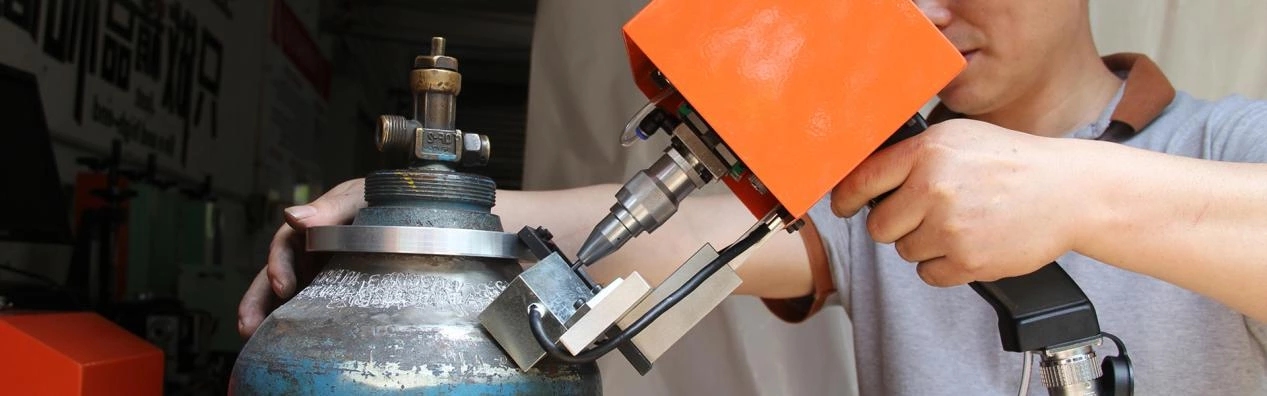
- Use a handheld route when cylinders are large, difficult to move or already installed in the field.
- Use a benchtop or supported station when repeatability, inspection speed and operator consistency matter more than free movement.
- Use rotary or guided support when the mark position or curvature makes uncontrolled rolling likely.
- Check the operator approach angle and visual access before approving the fixture concept.
For buyers evaluating station components, the dedicated pneumatic dot peen marker page is the right place to compare stable production setups against more flexible field-service routes.
4. Recommended Workflow From Preparation To Shutdown
A robust gas-cylinder process should be described as a workflow, not only as a machine list. That workflow gives production, maintenance and quality teams the same expectations.
- Prepare the cylinder and confirm the correct family, material condition and target mark zone.
- Seat the cylinder in the planned support or fixture and confirm rolling is controlled before marking begins.
- Load the approved content format and check serial sequencing or traceability input before the first part.
- Run the approved process recipe for that cylinder family and inspect the first code visually and functionally.
- During production, check readability, position consistency and any sign of fixture drift or stylus wear.
- At the end of the run, record the completed batch, clean the station, inspect consumable condition and leave the machine in a safe stopped state.
This workflow matters because cylinder projects often fail through small execution gaps: a support point shifts, the operator marks too close to an edge, or the first-part inspection never gets formalized. Those issues look like machine problems but are really process-definition problems.
5. Quality Checks That Prevent False Confidence
Quality checks for gas-cylinder marking should be specific and visible. A mark that looks acceptable at arm’s length may still fail if the content drifts on curvature, loses contrast after coating touch-up or does not align with the customer’s traceability scan. The quality plan should therefore state what is checked and how often.
- Confirm the mark is in the approved location and orientation on the cylinder or neck ring.
- Check the full character string, not only the first and last character.
- Verify readability after the expected cleaning, handling or repainting step when that is part of the use case.
- Review first-off and changeover parts whenever the fixture, operator or cylinder family changes.
- Keep sample photos and marked test pieces for customer signoff and repeat orders.
6. Downtime And Safety Belong In The Buying Decision
A buyer guide is incomplete if it only speaks about the mark and ignores daily operation. Cylinder-marking projects should also assess downtime and safety. If the line stops every time a support needs manual correction, the process will be blamed even if the mark quality is fine. If the station does not clearly control operator posture, part handling or the shutdown routine, small safety mistakes become repeat problems.
- Choose a fixture approach that reduces re-positioning and avoids unstable rolling during production.
- Define how operators load and unload heavy or awkward cylinders without improvised handling.
- Inspect stylus, support-contact points and code readability as part of a routine stop, not only after complaints.
- Document a clean shutdown routine so the next shift inherits a ready and safe workstation.
These details rarely appear in generic machine listings, but they strongly influence whether the plant experiences stable traceability or recurring rework.
7. Fast Comparison Table For Buyers
| If your project looks like this | Selection direction | What to verify in the sample |
|---|---|---|
| Large cylinders, field re-marking, difficult transport | Bias toward a handheld or highly flexible marking route | Operator access, code consistency on curvature and service-site ergonomics |
| Batch production with repeat traceability codes | Bias toward a supported station with controlled positioning | Fixture stability, batch repeatability, first-off inspection and downtime at changeover |
| Neck-ring or constrained marking zone | Bias toward a setup that prioritizes access angle and support design | Head clearance, mark location consistency and operator visibility during alignment |
| Repainting or harsh handling after marking | Bias toward a depth plan proven on the exact cylinder finish | Readability after the expected downstream abuse, not only immediate contrast |
8. Request A Practical Recommendation
If you are sourcing a gas cylinder marking machine, send cylinder photos, the target mark area, the required code content, expected daily output, and whether a rotary or support fixture is acceptable. That lets the team recommend a process around depth, curvature, traceability and uptime instead of guessing from a generic catalog request.
Compare Dot Peen Marking Machines
Review Pneumatic Dot Peen Options
Frequently Asked Buyer Questions
Should I choose the machine by cylinder diameter alone?
No. Diameter matters, but the real decision also depends on mark area, required depth, cylinder coating condition, traceability content, fixture access and whether the line needs batch consistency or field flexibility.
Is deeper marking always better for gas cylinders?
No. The mark must stay readable after transport, repainting and handling, but excessive depth can slow the cycle or create unnecessary deformation risk. Buyers should define the durability target first, then sample test the minimum stable depth.
When is a rotary or support fixture not optional?
If the code location sits on a curved shell, neck ring or unstable support point, a fixture is usually part of the process, not an accessory. It helps protect readability, repeatability and operator safety.
What should a buyer send before asking for a recommendation?
Send cylinder photos, material, mark area, content format, expected daily output, handling method and whether the plant can accept a rotary or support fixture. Those details reduce trial-and-error and make sample feedback useful.