
A Cost-Effective Fully Automated Steel Pipe Dot Peen Marking Demonstration
Industry: Energy and chemical equipment, hardware components
Material: Metal
The customer needed to mark short lengths of steel tubes of specific diameters and lengths, with lot numbers on the outside, and wanted a marking system that was as automated as possible, with high reliability and low maintenance. We used four sets of cylinder fixtures to achieve a fully automated loading, positioning, marking and unloading process. You can see the sequence of actions and their function in this video. The system is simple but reliable, inexpensive to implement, extremely cost-effective, and can be integrated into a fully automated tube production line in the form of a hairpin turn and marking according to the MES system's commands, with low deployment costs and little disruption to existing production or marking rhythms.
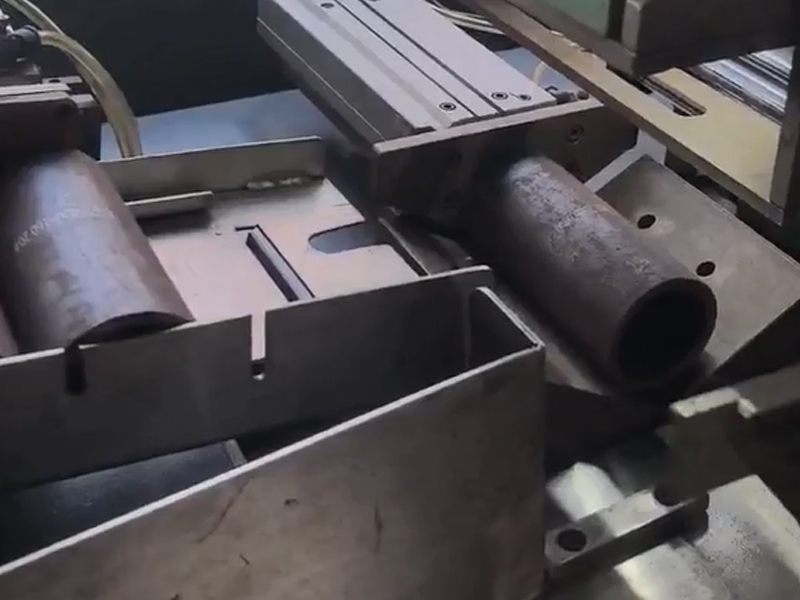
In the industrial world, the stylish fixture is often seen as the cornerstone of automation. The precise design and application of styles and fixtures for the movement and positioning of workpieces is the key to automated loading and unloading and accurate marking. Automation in this way is usually achieved using PLCs to control the movement and speed of the various nodes, resulting in a highly reliable and cost-effective automation solution. Due to the use of compressed air as a power source, cylinder fixtures are usually fast moving and make extensive use of limit devices to achieve precise stops, so that routine maintenance is simply a matter of checking for malfunctioning air hoses, throttle valves, and limits and replacing them in a timely manner.
If you are looking for an automated dot peen marking solution, please feel free to contact us for advice.
Application Context for A Cost-Effective Fully Automated Steel Pipe Dot Peen Marking Demonstration
Permanent metal marking applications need the right balance between marking depth, noise, cycle time and part geometry. Dot peen, scribe and custom rotary marking systems can solve different traceability requirements depending on the workpiece.
Recommended CNMarking Solutions and Internal Resources
If you are comparing equipment for a similar application, the following CNMarking pages are useful next steps:
- Dot Peen vs Laser Marking Guide – compare permanent marking methods for metal parts.
- Portable VIN Marking Machine for Chassis and Engine Codes – choose handheld dot peen marking for vehicle traceability.
- Handheld Scribe Marking Machine – review a low-noise scribing option for metal parts.
- Benchtop Flange Engraving Machine – see a flange and heavy-part marking configuration.
How to Choose a Similar Marking Setup
Before selecting a machine, prepare a short sample brief with the following information. This helps CNMarking recommend the right laser, dot peen, scribe or automation configuration instead of only matching a picture.
- Part material, hardness and marking depth
- Flat, curved, long or irregular workpiece shape
- Manual station, benchtop fixture or automated production line
- Code type such as VIN, serial number, Data Matrix or logo
Related Reading
- Portable VIN Marking Machine for Chassis and Engine Codes
- Handheld Scribe Marking Machine
- Benchtop Flange Engraving Machine
- Custom Rotary Dot Peen Marking Machine for Oil Drilling Rods and Bits
FAQ
Can CNMarking test my own samples before I choose a machine?
Yes. For most marking, cleaning and welding projects, sample testing is the fastest way to confirm contrast, depth, speed and fixture requirements before final configuration.
What information should I send for a quotation?
Please send the material, part size, marking or cleaning area, required result, production volume and any automation or traceability requirements. Photos or short videos of the current process are also helpful.