
Dot Peen vs Laser Marking — Which Technology Is Better for Your Metal Parts?
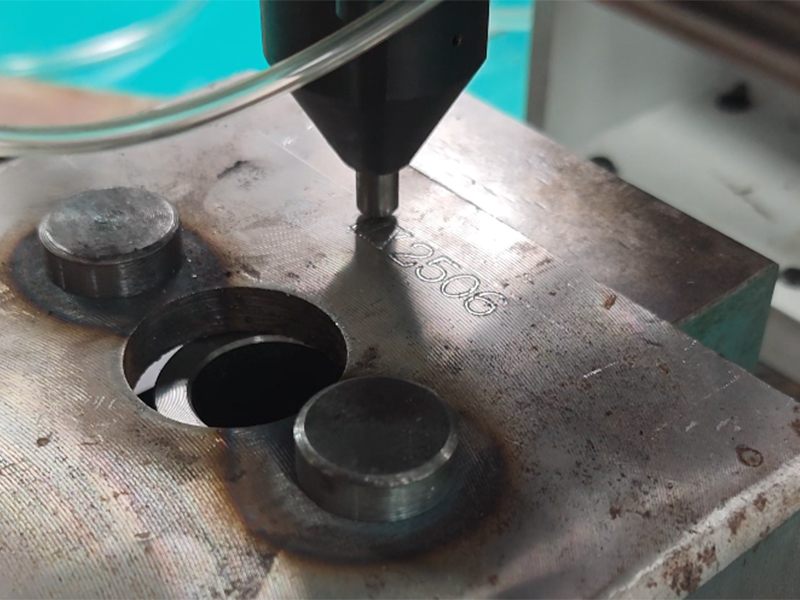
For industrial metal part marking, two technologies dominate: dot peen marking (also called pin marking) and laser marking. While both can produce permanent marks on metal, they work in completely different ways and suit different applications.
This guide compares both technologies across the factors that matter most in B2B manufacturing environments.
How Dot Peen Marking Works
Dot peen marking uses a pneumatic or electric stylus that strikes the material surface with controlled force, creating a series of dots that form characters, numbers, or 2D codes. The stylus physically displaces material, creating a deep, permanent indentation.
How Laser Marking Works
Laser marking uses a focused beam of light to alter the surface of the material. Depending on the laser type and settings, it can anneal, etch, or ablate the surface — creating high-contrast marks without physical contact.
Quick Comparison
| Factor | Dot Peen Marking | Laser Marking |
|---|---|---|
| Mark depth | 0.1–0.5 mm (deep) | 0.01–0.05 mm (surface) |
| Speed | Moderate | Very fast |
| Contact | Physical contact (pin strikes) | Non-contact |
| Material compatibility | Any metal, any hardness | Metals, some plastics |
| Mark contrast | Light gray/dark gray (depends on angle) | High contrast (black/white) |
| Maintenance | Needle replacement every 50k–200k marks | Minimal (50,000+ hrs laser life) |
| Operating cost | Low (needle + air) | Very low |
| Portability | Excellent (handheld models) | Limited (requires stable setup) |
When to Choose Dot Peen Marking
- You need deep, permanent marks that survive after welding, painting, or sandblasting
- You mark rough or curved surfaces where laser focus is difficult (e.g. cast iron, rough forgings)
- You need a portable handheld solution for large parts that can’t be moved to a machine (e.g. chassis frames, pipelines)
- You work with high-hardness materials like hardened steel, cast iron, or carbide
- Your environment has oil, dust, or vibration that interferes with laser optics
Explore our dot peen engraving machines and scriber marking machines.
When to Choose Laser Marking
- You need high-speed marking for mass production lines
- You require high-contrast marks (black annealing on stainless steel, bright marks on dark surfaces)
- You mark small,精密 parts with tight tolerance requirements
- You need to mark 2D data matrix codes or QR codes with high readability
- Your parts are finished/surface-treated and cannot be physically contacted
See our fiber laser marking machines for high-speed production marking.
Can You Use Both?
Many manufacturers use both technologies — dot peen for deep, permanent identification on rough parts, and laser for high-speed, high-contrast marking on finished components. CNMarking offers both systems, allowing you to standardize on a single supplier.
Summary
Choose dot peen when you need deep, permanent marks on rough or curved metal surfaces, or when portability is important.
Choose laser when you need speed, high contrast, and non-contact processing on finished parts.
Unsure which technology fits your application? Contact our team for a free sample test and recommendation.