
The Ultimate Guide to Laser Marking QR Codes and Data Matrix Codes: From Fiber to Picosecond
QR Codes and Data Matrix codes have become indispensable identification technologies in modern industry and daily life. QR codes, known for their high data capacity and fast reading speed, are widely used in product marketing, information access, and mobile payments. Data Matrix codes, valued for their high reliability in small areas and strong tolerance to damage, are the preferred choice for product traceability and Direct Part Marking (DPM) in demanding fields such as medical devices, electronic components, and aerospace parts. Laser marking technology, due to its permanence, high precision, and flexibility, is the preferred method for creating these codes on various materials. However, different laser types (such as fiber/MOPA, UV, CO2, green, infrared, and picosecond) are suitable for different materials, and parameter settings directly impact the success rate of code scanning. This article will delve into the considerations for using various laser marking machines in QR Code and Data Matrix applications, with a focus on the critical relationship between scan line width, code dimensions, and code grading.
Laser Types and Material Compatibility
Fiber & MOPA Lasers: These lasers typically operate at infrared wavelengths (1064 nm) and are the primary choice for marking metals (such as steel, aluminum, copper) and certain plastics. Standard fiber lasers produce high-contrast markings, while the MOPA (Master Oscillator Power Amplifier) architecture offers exceptional flexibility in adjusting pulse width and frequency, enabling high power output. This makes MOPA the mainstream configuration for high-power fiber lasers. This flexibility allows for finer control, enabling high-contrast black-and-white QR codes or DM codes with sharp, distortion-free edges. This facilitates scanning and achieves higher ratings.
UV Laser Marking Machine: Features a shorter wavelength, with 355 nm being the most mainstream option. Its high photon energy makes it suitable for heat-sensitive materials (such as most plastics, glass, and ceramics) and fine marking applications. UV lasers enable so-called “cold processing,” removing material through photochemical reactions rather than thermal effects, thereby minimizing thermal damage and material deformation. Additionally, UV laser marking produces a smaller spot size, enabling scan line widths of 0.01–0.002 mm even without specialized optical path design. This is particularly advantageous for marking small-sized DM codes or QR codes on brittle materials, flexible circuit boards, and other micro-components, ensuring the geometric precision of the modules. Based on our own testing, standard UV laser marking machines can achieve Grade A QR codes measuring 2mm x 2mm or Grade B QR codes measuring 0.5mm x 0.5mm on glass or plastic substrates.
CO₂ laser marking machines utilize a 10.6 μm long wavelength that is efficiently absorbed by organic materials, creating contrast through carbonization or foaming. However, their marking spots and heat-affected zones are relatively large, resulting in wider line widths. When marking QR codes or Data Matrix codes, precise control of power and speed is essential to prevent material charring that could cause module adhesion or deformation, this is a significant challenge especially with small-sized codes. Consequently, CO₂ laser marking machines are currently primarily limited to marking QR codes on wooden products, with applications being less widespread compared to fiber and UV lasers.
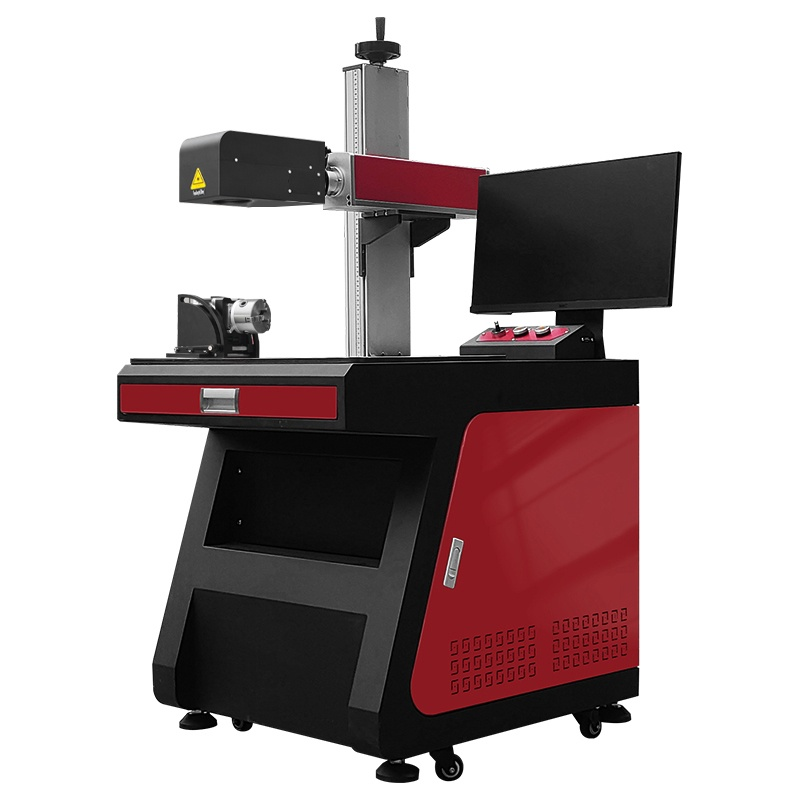
Green laser marking machines currently have relatively niche applications. Most materials suitable for green light can be effectively marked using ultraviolet lasers. Therefore, green lasers are primarily used for their unique marking characteristics on a limited number of materials. On metals, green lasers enable black-and-white marking on materials like copper, brass, and glass, facilitating easily scannable, high-grade codes. This is particularly advantageous for marking precision components requiring automated scanning and grading on production lines. Due to relatively narrow applications and production volume factors, even though the double-frequency cavity used in 532nm green lasers (also employing DPSS solid-state lasers as pump sources) theoretically costs less than the triple-frequency cavity used in UV lasers, the actual production or procurement cost of such green lasers is often higher.
Picosecond Laser Marking Machines: Picosecond pulse widths (10^-12 seconds) drastically reduce the interaction time between laser and material, virtually eliminating thermal diffusion and enabling true “cold” ablation. While models with different wavelengths exist, the most suitable type and power are typically selected based on actual material testing. This ultra-short pulse laser is suitable for nearly all materials, particularly brittle materials (such as sapphire, glass, medical-grade polymers) and precision components requiring an absolutely minimal heat-affected zone (HAZ). The two most common applications today are: The other involves precisely controlling the incidence angle during picosecond laser marking to create invisible QR codes detectable only at specific angles or by specialized instruments. This technology is currently primarily used for quality traceability on display panels.
The Relationship Between Scan Line Width, Code Dimensions, and Grading
The scanning reliability of QR Codes and Data Matrix codes depends on their grading (typically following ISO/IEC standards, such as ISO/IEC 18004 for QR codes and ISO/IEC 16022 for Data Matrix). The grading, from high to low (e.g., A to F or 0 to 4), evaluates multiple parameters including decode, contrast, axial non-uniformity, grid non-uniformity, and unused error correction. Among these, scan line width, code dimensions, and contrast are the core elements directly controllable by the laser marking process.
Importance of Scan Line Width and Scan Line Spacing
The scan line width is determined by the laser spot diameter, energy density, and the material’s laser absorption rate. For fixed equipment and specific materials, the scan line width is a non-adjustable fixed value that dictates the minimum module size of scannable QR or DM codes. If you require marking extremely small codes, it is essential to send samples for actual marking tests and obtain ratings from third-party testing agencies to ensure usability after purchasing the equipment.
Key Influencing Factors on Grading
The laser marking process must systematically optimize the following aspects to ensure a high grade:
Contrast: This is one of the most critical parameters in rating, defined as the difference in reflectance between dark modules (marked areas) and light modules (substrate). Laser marking creates contrast by altering the surface color of materials (through oxidation, engraving, discoloration, etc.). Parameter optimization is critical: Insufficient power results in faint marks and poor contrast; excessive power may burn the material or cause excessive diffusion, similarly reducing contrast. For combinations of different materials (e.g., light marks on black plastic or dark marks on shiny metal), lasers with appropriate wavelengths and pulse parameters must be selected.
Module Uniformity & Geometric Accuracy: A high grade requires all modules to be regularly shaped, consistently sized, and accurately positioned. This demands good laser beam quality (circular Gaussian or top-hat profile), high positioning accuracy of the scanning system, and stable process parameters. Thermal effects can cause module edges to “swell” or deform. Therefore, for precision small codes, cold-processing lasers like UV or picosecond should be prioritized. The L-shaped finder pattern of a Data Matrix code must be清晰 and straight, which is crucial for positioning and decoding.
Quiet Zone: The quiet zone is a deal-breaker in code grading. The laser marking program must ensure a sufficiently wide area completely free of any marks, scratches, or background interference is reserved around the code. For Data Matrix codes, the quiet zone width should be at least one module size.
Surface Condition: The substrate’s surface roughness, flatness, curvature, and original color all affect the final marking result and grade. Marking on rough surfaces may require adjusting the focal length or using a larger line width to ensure continuity.
Considerations and Best Practices
Material and Laser Compatibility Testing
Comprehensive sample testing is essential before mass production. Create a parameter matrix, systematically varying laser power, scan speed, frequency (and pulse width, if available), and evaluate the line width, contrast, and final scan grade of the code under each condition. Use an automatic code verifier for objective assessment.
Environmental and Durability Considerations
Marked codes may be exposed to abrasion, chemicals, high temperatures, or outdoor environments. Durability testing corresponding to the end-use environment is mandatory, such as salt spray testing, artificial sweat testing, damp heat testing, abrasion testing, etc. The depth and mechanism of laser marking (whether it’s surface discoloration or physical engraving) determine its durability.
Comprehensive Verification
Do not rely on a single type of scanning device for verification. Test with multiple code readers, including smartphone cameras, handheld industrial imager scanners, and fixed high-performance verifiers. This ensures the code’s broad readability across various real-world usage scenarios.
Regular Maintenance and Calibration
Laser output power, beam mode, cleanliness of focusing lenses, and galvanometer calibration can drift over time. Establishing a regular preventive maintenance schedule, including cleaning optical components, calibrating beam alignment and focal position, and verifying marking dimensional accuracy, is fundamental to maintaining stable, high-quality marking output.