Fiber Laser vs MOPA Laser Marking: Parameters, Materials and Use Cases
Industrial comparison guide
“Fiber laser” and “MOPA laser” are often treated like a simple upgrade ladder, but the buying decision is not that tidy. Many industrial marking jobs on steel, aluminum and coated parts do not fail because the buyer chose the wrong source label. They fail because the requested contrast, heat effect, depth boundary, scanner readability or part-handling rhythm was never defined before the quotation was accepted.
This guide helps distributors, process engineers and OEM buyers compare fiber laser versus MOPA laser marking in a practical B2B way. It covers suitable materials, heat input and contrast behavior, depth boundaries, throughput, maintenance, cost inputs and selection logic. It does not invent universal machine speeds, fixed pulse recipes or one-size-fits-all power claims, because the correct process still has to be proven on the real part and acceptance standard.
- Which materials and mark objectives usually fit a standard fiber process and which ones often justify MOPA sample testing.
- How heat input, contrast, color control and depth expectations shift the buying conversation.
- Why throughput, maintenance and cost inputs can overturn an apparently obvious source choice.
- How to build a practical sample-test and quotation brief before asking for a final recommendation.
Start with the Required Result, Not the Source Label
A standard fiber laser marking machine can be the right answer when the job is straightforward industrial traceability: text, serial numbers, logos, production codes or matrix marks on ordinary metal parts where the priority is stable readability, repeatable workflow and reasonable ownership cost. A MOPA-configured process becomes more relevant when the requested result depends on tighter heat control, more specific surface interaction or a wider visual result window.
That means the first question should be: what exactly must the mark look like and survive? For some buyers the answer is simple scanner readability. For others it is black marking on stainless steel, controlled ablation on anodized aluminum, visually clean codes on reflective material, or a narrow heat-affected zone next to a cosmetic surface. Until those acceptance points are written down, “fiber vs MOPA” is only a label debate.
Where a Standard Fiber Process Is Often Enough
Standard fiber marking remains commercially strong when the job values robust traceability on common metals, stable shop-floor deployment and lower complexity. If the goal is permanent identification on steel or aluminum parts and the mark does not depend on color effects or unusually narrow heat control, a buyer may gain more from good fixturing, scanner verification and process discipline than from moving immediately to a MOPA source.
- Production codes, serial numbers and logos where the main acceptance target is readable, repeatable contrast.
- Workflows that need consistent operator training, stable uptime and clear maintenance routines more than expanded pulse tuning.
- Jobs where the part is already well constrained, the code content is fixed and downstream verification is straightforward.
- Programs where the budget must prioritize fixture design, extraction, automation or code validation rather than a broader source-control window.
This is why many buyers should compare source choice together with the rest of the marking cell. A standard fiber process backed by good fixtures, validation logic and the right scanner verification workflow can outperform a poorly integrated MOPA purchase that never stabilizes in production.
Where MOPA Often Deserves Serious Sample Testing
MOPA enters the conversation when the mark requirement is more sensitive to pulse behavior and surface response. That does not mean MOPA automatically wins every premium project. It means the buyer should test it when the requested result sits close to the line where ordinary fiber recipes become hard to control economically or cosmetically.
| Mark objective | Why buyers look at MOPA | Boundary to verify before approval |
|---|---|---|
| Black or dark marking on stainless steel | Projects may need more controlled heat behavior and visual consistency than a basic traceability mark. | Check color stability, repeatability after cleaning and whether the mark must stay visually uniform across production batches. |
| Controlled ablation on anodized aluminum or coated surfaces | The project may need clean layer removal without rough edges or obvious rework. | Test edge definition, substrate protection and whether downstream appearance standards stay acceptable. |
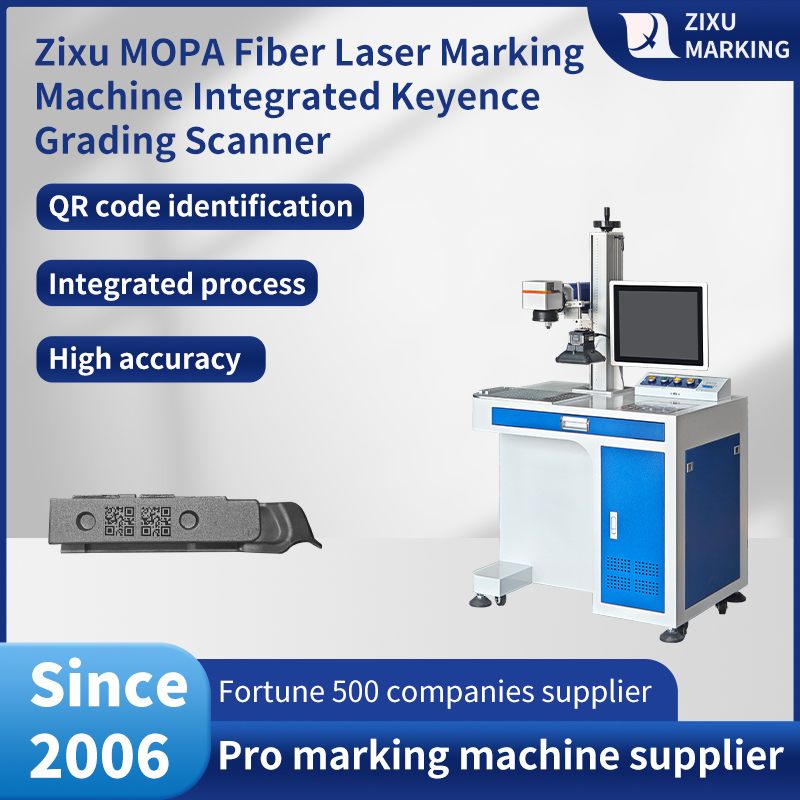
| Fine QR or Data Matrix marks with strict grading expectations | Some parts benefit from a wider process window when contrast and cell definition must be balanced carefully. | Verify the real scanner grade, not just visual appearance under one lighting condition. |
| Special visual effects or more delicate cosmetic surfaces | Buyers may need tighter control of heat tint, edge cleanliness or visible surface change. | Approve the exact cosmetic boundary with the final customer before treating MOPA as a solved answer. |
Those are precisely the kinds of jobs where the buyer should review related CNMarking examples such as MOPA color marking on stainless steel and then run a real sample program against the target material and inspection standard. The right source decision is the one that survives production variation, not the one that looks most advanced in a brochure.
Heat Input, Contrast and Depth Are Not the Same Question
Source selection often goes wrong because three different goals get blended together: visible contrast, controlled heat effect and physical depth. A buyer who needs a scanner-readable dark code on stainless steel may need a very different process window from a buyer who needs a visibly deep permanent mark on a rough forged part. Likewise, a buyer who wants cosmetic color control on anodized aluminum is solving a different problem from one who only needs a clean white or light contrast.
| Decision factor | Standard fiber discussion | MOPA discussion | What the buyer should measure |
|---|---|---|---|
| Heat effect on the surface | May be fully acceptable for ordinary industrial identification tasks. | Can be worth testing where the surface response must be controlled more narrowly. | Visible heat tint, cosmetic change, edge cleanliness and post-cleaning appearance. |
| Dark contrast or color window | May meet the requirement when the part standard is simple. | Often enters consideration when the customer asks for more specific visual results. | Repeatability across samples, lighting conditions and scanner or operator checks. |
| Physical depth | Depth depends on far more than the source label and must be proven on the material. | MOPA should not be treated as an automatic answer to every deep-mark requirement. | Real depth, edge integrity, fatigue risk and whether the part standard accepts the surface change. |
| Code readability | Often sufficient when the part, coating and scanner setup are stable. | Can provide a more forgiving process window in some difficult materials or cosmetic jobs. | Scanner grade, reject rate and performance after handling, oil, cleaning or coating steps. |
This is also why buyers should not ask for fixed parameters from another factory and copy them into a new part. The same source can behave differently when the alloy, finish, coating, fixture stability or code size changes. A useful quotation requires sample boundaries, not only a machine family name.
Throughput and Production Rhythm Can Reverse the Decision
A MOPA option can look attractive when the sample mark is visually better, but the production choice still depends on how the whole process behaves at shift level. If the mark is excellent but the process requires narrow setup discipline, more operator intervention or tighter environmental control, the total commercial value may drop. On the other hand, if a standard fiber route causes repeated scanner failures or cosmetic rework, the apparently cheaper source can become the expensive path in real production.
- Measure total takt time, not only beam-on time. Include loading, fixture checks, marking, verification and unload.
- Count rejected or reworked parts under the same inspection standard that production will really use.
- Check whether the process stays stable on low, normal and difficult sample sets rather than one ideal coupon.
- Confirm whether the chosen source still works when the mark position is curved, the surface finish changes or a coating lot shifts slightly.
For scanner-driven jobs, the more relevant question is often “Which source keeps the grade stable with the least production friction?” rather than “Which source produced the prettiest first sample?”
Maintenance and Cost Inputs Buyers Commonly Miss
Source choice is only one part of cost. Buyers often underweight fixturing, extraction, optics protection, operator training, scanner setup, spare-part planning and service response. Those items matter because they decide whether the process remains profitable after the first demonstration.
| Cost input | Why it matters in the fiber vs MOPA decision | Question to ask before buying |
|---|---|---|
| Fixture and positioning discipline | A stable source choice can still fail if the part does not sit repeatably in the same mark zone. | Will the final quotation include or reference the actual fixture concept and the allowable part-position tolerance? |
| Extraction and optics cleanliness | Some materials and coatings punish optics and visibility faster than the quote assumes. | Has the supplier seen the real plume, residue and shift-level contamination load? |
| Verification and rework logic | Rejected codes or cosmetic fails quickly erase a small capital-price difference. | How will the mark be checked, and what happens operationally when it fails the standard? |
| Operator training and recipe control | A broader source window still needs disciplined recipe control to stay profitable. | Can the process be handed to normal production staff without depending on one expert operator? |
A smart B2B comparison therefore uses a full ownership lens: source cost, cell cost, verification cost, rework risk and service stability. The best source is the one that meets the mark standard with the lowest verified total process burden, not the most technically interesting label.
Use This Selection Table Before Requesting a Final Quotation
| If the project mainly needs… | Commercial starting point | What to test before deciding |
|---|---|---|
| Ordinary metal traceability with stable readability | Start from a standard fiber process and optimize the cell around it. | Scanner pass rate, fixture repeatability and shift-level stability. |
| Black marking, delicate contrast control or cosmetic sensitivity | Move MOPA into the sample-test shortlist early. | Visual consistency, heat effect, cleaning resistance and customer acceptance. |
| Anodized-layer ablation or coating-sensitive surface marking | Compare both sources only on the real substrate and finished appearance standard. | Edge quality, substrate protection and rework risk after production handling. |
| Permanent depth requirements in harsh environments | Do not assume source type alone solves the requirement. | Actual depth, fatigue implications, edge integrity and compliance with the final specification. |
The safest next step is to send real samples and a written acceptance brief. Include material type, finish, coating, mark content, part geometry, target contrast or depth, daily volume, fixturing concept and downstream verification method. That gives the supplier enough information to compare a standard fiber process with a MOPA route honestly instead of selling whichever label sounds more advanced.
Frequently Asked Questions
Is MOPA always better than a standard fiber laser for metal marking?
No. MOPA gives the operator a wider pulse-control window, but that only matters when the mark requirement actually needs it. For many serial numbers, logos and traceability jobs on ordinary metals, a standard fiber process can remain the better commercial fit.
When should a buyer insist on a sample test before choosing between fiber and MOPA?
Use a sample test whenever the project depends on black marking, controlled heat tint, anodized-layer ablation, delicate QR readability, visible contrast on reflective metals or any result that could fail after coating, cleaning or scanner verification.
Can MOPA replace deep mechanical engraving for every permanent mark?
No. A MOPA setup can help some contrast and controlled-ablation tasks, but permanent-depth requirements, fatigue exposure and harsh-environment specs still need to be checked against the real standard instead of assumed from the source type alone.
What should a quotation request include for a fiber versus MOPA decision?
Send the real material, surface condition, target mark content, readability or depth requirement, part geometry, daily volume, fixture concept, downstream scanner or customer standard, and photos or sample parts from the actual production job.