
How Fast Is Laser Cleaning? 7 Factors That Affect Cleaning Speed
How Fast Is Laser Cleaning? 7 Factors That Affect Cleaning Speed
The actual processing speed of laser cleaning does not have a fixed standard. It is influenced by multiple factors such as the material of the substrate, the type of contaminants, laser parameters, and the target cleanliness level.
For situations involving thin rust stains or oxide layers, laser cleaning machines can achieve large-area and rapid processing. However, if dealing with thick coatings, severe rust, or precision cleaning scenarios, the scanning speed needs to be reduced, or multiple cleaning operations are required. The stated cleaning speed of the equipment can only serve as a reference and cannot be directly equated to the actual production efficiency.
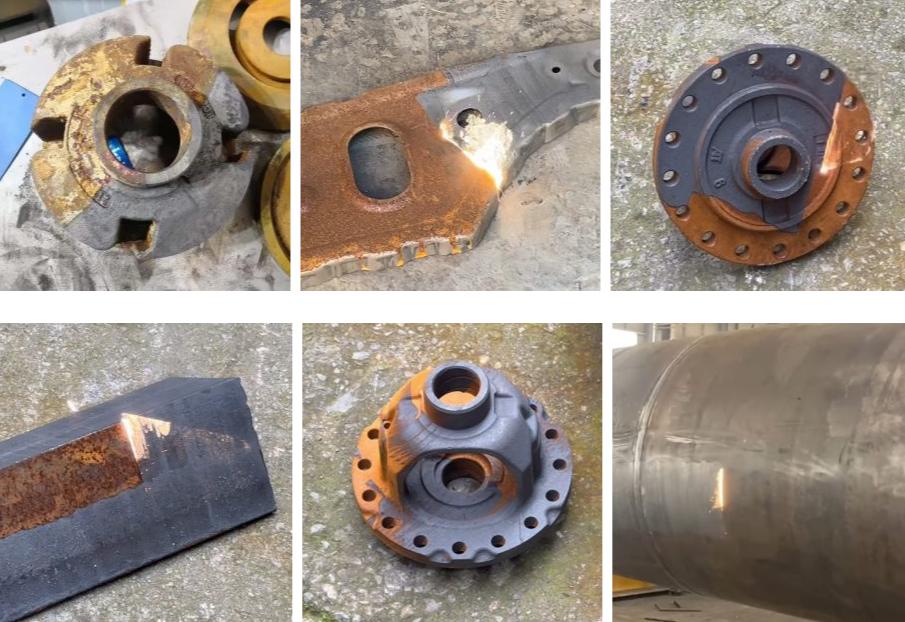
Typical Laser Cleaning Speeds
Laser cleaning efficiency is commonly expressed in square meters per hour (m²/h), but the actual figure can vary considerably between applications.
For example, a laser cleaning machine may achieve different results depending on the laser source and the material being processed. As a reference, some industrial laser cleaning systems can achieve the following cleaning efficiency when removing approximately 50 μm of rust:
| Laser Cleaning System | Example Cleaning Efficiency |
| CW Laser Cleaning | 12–80 m²/h |
| Pulsed Laser Cleaning | 4–21 m²/h |
These figures should not be interpreted as fixed cleaning speeds for every application. Rust thickness, surface condition, material type, laser settings, and the required cleaning result can all change the actual processing rate.
A useful distinction is between scanning speed and effective cleaning speed. Scanning speed describes how quickly the laser beam moves across the surface, while effective cleaning speed considers whether the contamination can be completely removed within the required number of passes.
7 Factors That Affect Laser Cleaning Speed
1. Laser Power
Laser power determines how much energy can be delivered over a given period. In general, higher power provides greater potential for faster material removal, particularly when cleaning large surfaces or heavier contamination.
However, higher power does not automatically mean proportionally higher cleaning speed. Excessive energy can increase heat input and may affect the substrate, while the appropriate power level depends on the material and contamination being removed.
2. Type and Thickness of Contamination
Different contaminants require different amounts of laser energy to remove.
A thin layer of surface oxidation may be removed relatively quickly, while thick rust, paint, carbon deposits, or tightly bonded coatings can require slower scanning or several passes.
Contamination thickness is therefore one of the most important factors when estimating cleaning time. A speed achieved on a thin rust layer should not be used as a direct reference for a much thicker coating.
3. Workpiece Material

The material being cleaned also affects the result. Metals such as steel, stainless steel, aluminum, and copper interact with laser energy differently because of differences in reflectivity, absorption, and thermal properties.
The cleaning parameters must therefore be adjusted according to the substrate. A setting that works efficiently on one metal may not provide the same result on another.
4. Scanning Speed
The scanning speed directly determines the duration of the laser’s action in a local area.
If the scanning speed is too fast, the output energy is insufficient, making it difficult to completely remove the contaminants. Lowering the scanning speed can increase the energy input per unit area, but too low a speed will reduce production efficiency and cause heat accumulation.
In actual operations, there is no need to blindly pursue higher scanning speeds. The key is to find a balance point, ensuring the cleaning effect while avoiding damage to the substrate.
5. Spot Size and Cleaning Width
The laser spot size affects how energy is distributed across the surface. A smaller spot can concentrate energy into a smaller area, which can be useful for detailed or precision cleaning. A larger spot or wider cleaning pattern can provide greater coverage for large surfaces.
However, increasing the coverage area does not automatically increase effective cleaning speed. The available energy still needs to be sufficient for the contamination being removed.
6. Pulse Frequency and Pulse Duration
For pulsed laser cleaning, pulse frequency and pulse duration can influence both cleaning performance and processing efficiency.
Pulse frequency determines how many laser pulses are delivered per second, while pulse duration affects how energy is delivered to the material. These parameters work together with pulse energy, scanning speed, and spot size.
Simply increasing pulse frequency or changing pulse duration does not necessarily produce faster cleaning. The parameters need to be balanced according to the application.
7. Number of Passes and Cleaning Requirements
The number of passes can have a significant effect on overall processing time.
For some applications, one pass may be sufficient to remove the target contamination. Other surfaces may require multiple passes to achieve the desired result, particularly when dealing with thick or uneven contamination.
The required level of cleanliness also matters. Removing most visible contamination and completely exposing a clean substrate are not necessarily the same task.
Evaluating Laser Cleaning Speed for Your Application
Laser cleaning can be fast, but there is no universal cleaning speed. Laser power, contamination, workpiece material, scanning speed, spot size, pulse parameters, and the number of passes all influence the final result.
For industrial applications, Zixu provides laser cleaning machines for different surface cleaning requirements. Testing the actual material and contamination can help determine suitable parameters and provide a more realistic estimate of cleaning performance.