
100W Pulsed Laser Cleaning Vavles On-site from Our Local Flange and Vavle Manufacturing Customer
We utilize a 100W JPT pulsed cleaning laser to efficiently remove a thin layer of rust (ranging from 0.5 to 1.5 μm) from the surface of our customers’ valves. These valves are manufactured from pig iron, a material that rapidly develops a thin gray oxide layer upon exposure to air before gradually transitioning into rust. To address this issue, we previously designed a customized ultrasonic vibratory cleaning line for the customer, which included the hanger conveyor system seen here. However, due to the high power consumption and significant water usage associated with ultrasonic cleaning, the customer decided to transition to a more efficient and eco-friendly pulsed laser cleaning solution.
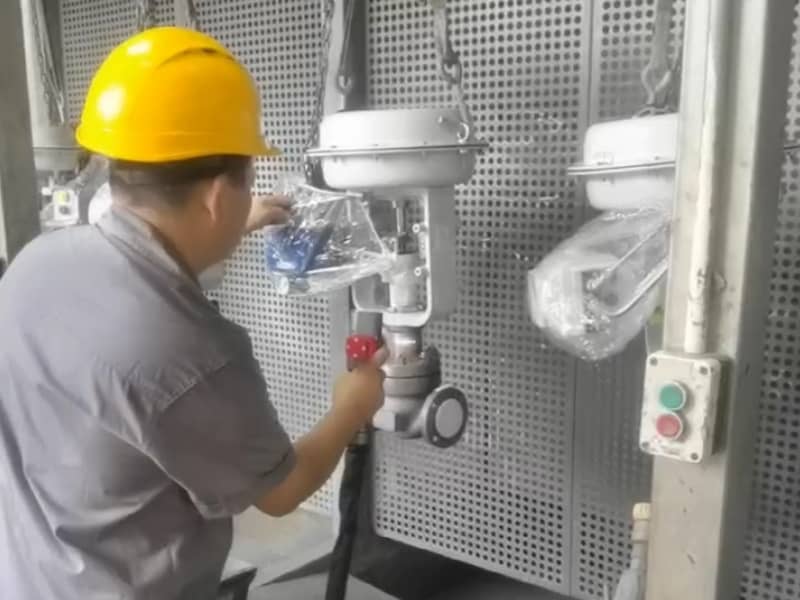
Last month, the customer invited us to conduct an on-site sample cleaning test to evaluate the performance of our laser systems. We provided three options: 100W, 200W, and 300W handheld pulsed laser cleaners. After thorough testing, the 100W model was selected as the most cost-effective solution for their needs. While the 200W model offers a slight improvement in cleaning speed, the difference was not substantial enough to justify the higher cost for such thin rust layers. The 300W model, on the other hand, cleans 50% faster but comes with a price increase of over 50%, making it less economical for the customer’s current requirements.
To further enhance efficiency, we also proposed automated and semi-automated cleaning solutions that could integrate with the existing boom and pneumatic suction cup rotators on their production line. However, given the relatively low efficiency demands for cleaning outside the warehouse, the customer has postponed adopting these advanced solutions for now. That said, we remain open to future retrofitting opportunities should their production needs expand or business conditions improve.
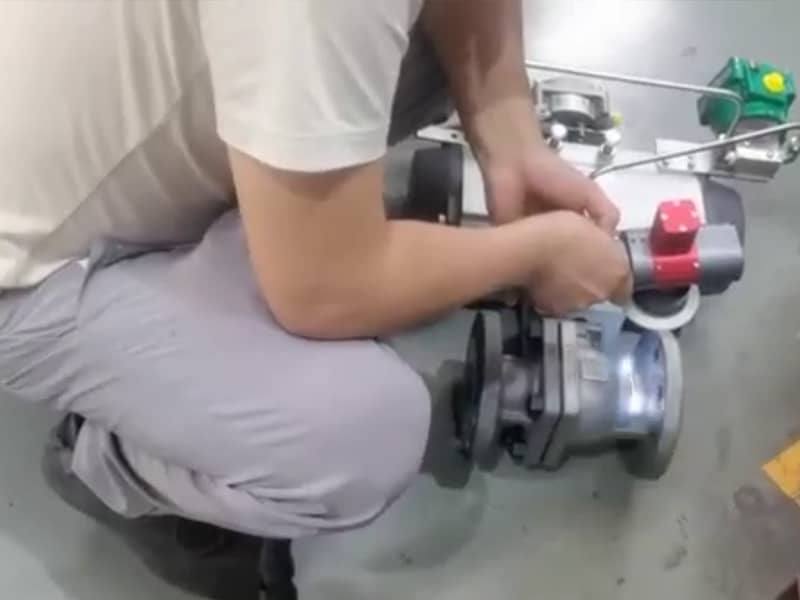
If your operations involve similar rust removal challenges—whether for valves, machinery, or other metal components—we would be happy to assess your requirements and recommend the most suitable laser cleaning solution. Contact us today to discuss how we can optimize your cleaning process with advanced laser technology!
Application Context for 100W Pulsed Laser Cleaning Vavles On-site from Our Local Flange and Vavle Manufacturing Customer
Laser cleaning applications usually depend on substrate material, coating thickness, heat sensitivity and required throughput. For similar projects, CNMarking normally confirms the contaminant type, target surface quality and whether pulsed or CW laser cleaning is more suitable before recommending a machine configuration.
Recommended CNMarking Solutions and Internal Resources
If you are comparing equipment for a similar application, the following CNMarking pages are useful next steps:
- Pulsed Fiber Laser Cleaning Machines Guide – compare pulsed laser cleaning for rust, paint, oxide and precision surface treatment.
- 300W Pulsed Laser Cleaning for Semiconductor Reflow Carrier Trays – see a detailed customer cleaning test with process photos.
- SANY Group 3000W CW Laser Cleaner Case – review a heavy-industry laser cleaning cost reduction case.
- Live Demonstration: Laser Welding Mark Removal – understand on-site cleaning for weld marks and metal surfaces.
How to Choose a Similar Marking Setup
Before selecting a machine, prepare a short sample brief with the following information. This helps CNMarking recommend the right laser, dot peen, scribe or automation configuration instead of only matching a picture.
- Substrate material and coating thickness
- Required cleaning width, speed and repeatability
- Whether the job needs pulsed precision cleaning or high-power CW removal
- Fume extraction, enclosure and operator safety requirements
Related Reading
- 300W Pulsed Laser Cleaning for Semiconductor Reflow Carrier Trays
- SANY Group 3000W CW Laser Cleaner Case
- Live Demonstration: Laser Welding Mark Removal
- How to Choose the Right Laser Marking Machine for Your Factory
FAQ
Can CNMarking test my own samples before I choose a machine?
Yes. For most marking, cleaning and welding projects, sample testing is the fastest way to confirm contrast, depth, speed and fixture requirements before final configuration.
What information should I send for a quotation?
Please send the material, part size, marking or cleaning area, required result, production volume and any automation or traceability requirements. Photos or short videos of the current process are also helpful.