
Contact Us
Galvo Laser Scanner vs 2D/3D Laser Marking: What Manufacturers Should Know
It is vital to select an optimal system for the sake of ensuring consistency in marking results and efficiency in the manufacturing process. Yet, in some cases, one can be faced with the question: which system to buy? The standard Galvo scanner, a 2D system, or a 3D laser marking system?
The answer depends on the technology of the beam control and the ability to accommodate various surfaces of workpieces. The knowledge of the difference will help manufacturers avoid unnecessary features in their systems.
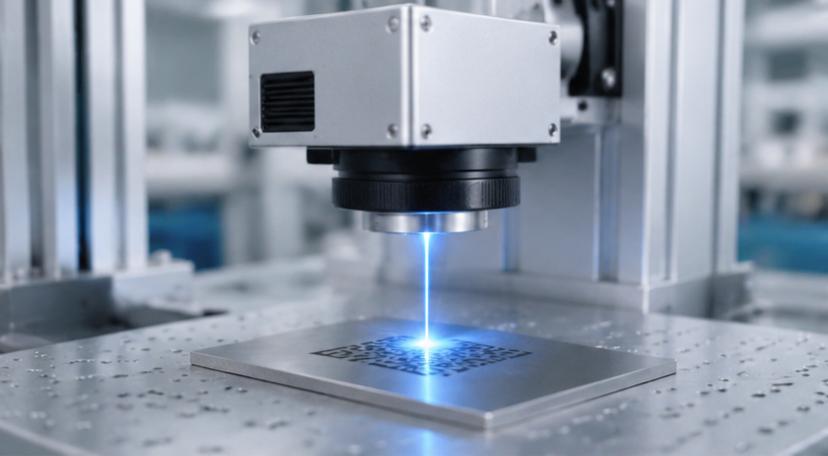
Galvo Scanner vs. 2D/3D Laser Marking: What’s the Difference?
In the case of Galvo laser scanners, high-speed galvanometer-controlled mirrors are used to control the laser beam on the workpiece. This system allows for rapid and accurate positioning of the beam without the need to move the whole laser head.
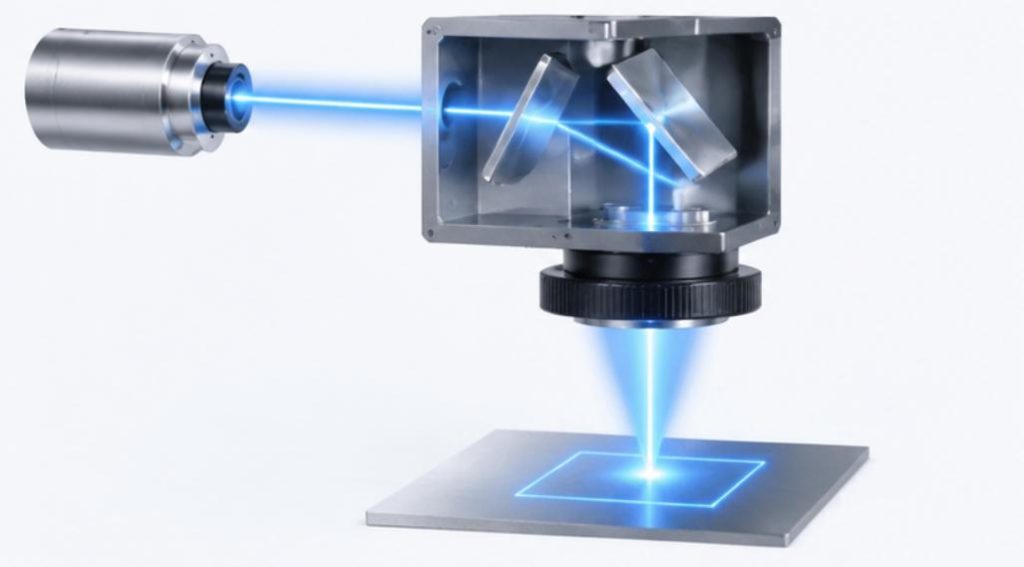
However, Galvo scanners are not restricted to a single marking technique. They can be used in both 2D and 3D laser marking systems.
The key distinctions are:
- 2D Laser Marking – involves using X and Y scanning axes to mark flat surfaces at a constant focal plane.
- 3D Laser Marking – involves the inclusion of dynamic focusing, which allows changing the focal position of the laser beam along the Z-axis.
- Galvo Scanner – is responsible for controlling the movement and positioning of the laser beam in both systems.
To sum up, the galvo system defines how the beam moves, while 2D and 3D systems define how to process the workpiece surface.
2D vs. 3D Laser Marking: Key Performance Differences
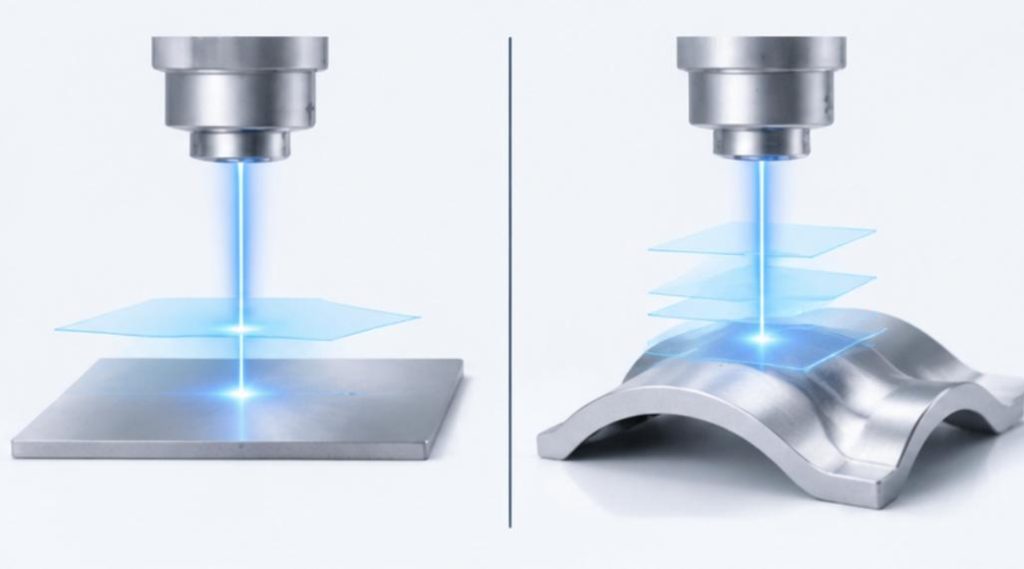
In spite of the similarity of the two technologies in using a laser scan, there are some differences between their configurations and capabilities.
| Comparison | 2D Laser Marking | 3D Laser Marking |
| Surface type | Flat surfaces | Curved and uneven surfaces |
| Focusing | Fixed focal plane | Dynamic focusing |
| Processing area | Flat marking field | Height-variable marking volume |
| Typical applications | QR codes, logos, serial numbers | Curved components, complex surfaces |
| System configuration | Relatively simple | More advanced optical and control systems |
| Investment | Generally lower | Generally higher |
2D Laser Marking
A 2D system usually has an XY Galvo Scanner together with an F-Theta lens. The lens projects the laser light to form a focal position through the flat marking area.
This is appropriate for printing various identification numbers or images on flat metal plates, electronic parts, and industrial equipment.
3D Laser Marking
In 3D laser marking, a dynamic focus technique is used to change the position of the focal point.
Such laser marking is effective for marking car parts, curved metal surfaces, and molded parts, among others.
For businesses that work with non-flat material, it helps to minimize problems with marking due to focal issues and improve processing flexibility.
When Should Manufacturers Choose 2D or 3D Laser Marking?
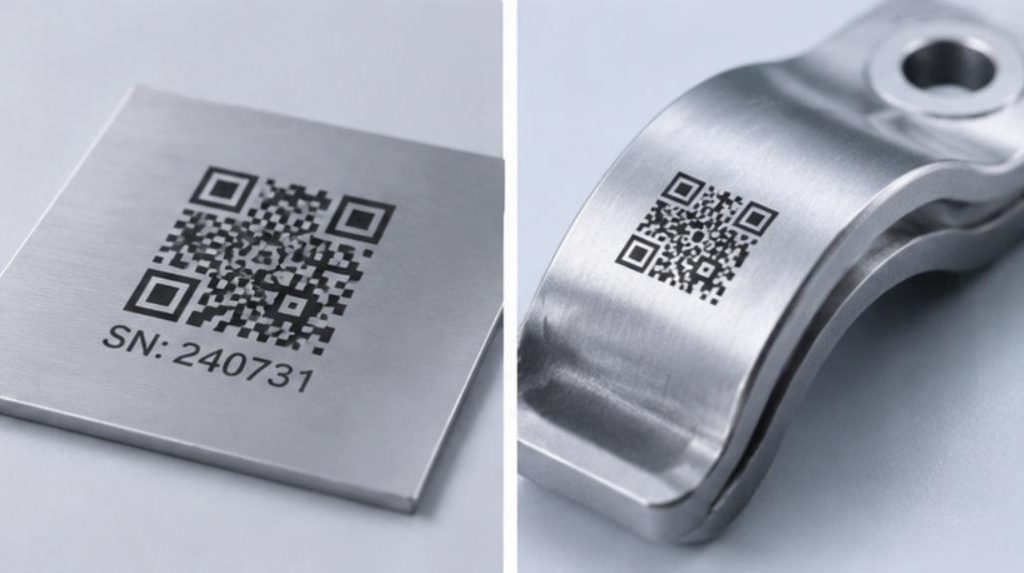
Which one to use depends mostly on the workpiece’s geometry and the marking specifications.
Use 2D Laser Marking When:
- You have flat workpieces.
- You want to mark QR codes, barcodes, serial numbers, or logos.
- Fast marking and an easy production process are your top concerns.
- Your application does not need continuous focus adjustments.
Go for 3D Laser Marking When:
- Your objects have irregular or curvy surfaces.
- You need to mark pieces with height differences.
- Precision focus on all the surfaces is needed.
- You perform any special engraving process.
The first thing that must be taken into account is that being equipped with 3D technology does not necessarily mean it is suitable for all kinds of applications. If you deal with flat pieces, then a properly adjusted 2D machine will suffice.
What Does a Galvo Scanner Mean for Marking Performance?
Galvo scanners directly affect beam motion and Positioning. When choosing laser marking equipment, there are several things to be taken into account by the manufacturer.
- Speed of Marking: With galvo scanner mirrors working at high speed, the laser beam can quickly traverse the marking field. This is important for manufacturers with large-scale component production and product identification.
- Accuracy of Positioning: The accuracy and consistency of scanning determine how well fine text, small QR codes, and complex images can be marked. It is especially important in the electronics industry and in precision manufacturing.
- Scanning Area: The scanning area is where the marking area can be determined. But it is not necessarily the case that having a bigger scanning area means better results. Lens choice, focal spot size, and optics design all contribute to the quality of marking.
- Dynamic Focusing: In the case of three-dimensional markings, dynamic focusing coordinates with the scanning system in terms of the X-Y axes to achieve appropriate focusing.
- Consistency: Proper scanner setup, quality optical parts, and well-chosen control software are required to keep production consistent.
5 Factors to Consider Before Choosing a Laser Marking System
Manufacturers should consider the following factors before buying the laser marking machines:
- Workpiece geometry: It should be determined what kind of surfaces your parts have (flat, curved, angled, uneven).
- Material type: It should be considered what material you process (stainless steel, aluminum, plastics, glass, wood, etc.). Fiber, UV or CO2 laser should be used depending on material properties and processing demands.
- Marking demands: It should be identified what kind of marking you need (surface, deep engraving, relief engraving, product marking).
- Production Volume: It is necessary to take into account the speed and automation of the marking process.
- Working Area: It should be ensured that the marking field provides the required marking quality for your workpiece sizes.
Considering these factors prior to purchase will prevent any excessive expenses on equipment.
Final Thoughts
The functions of galvo scanners, 2D laser marking systems, and 3D laser marking systems are somewhat different, although similar and connected to each other. Although the role of a galvo scanner is to control the beam of a laser, the difference between 2D and 3D marking systems comes from the characteristics of workpieces and the goals of manufacturing.
The best way of making the laser marking process is not the one with the most complicated technology, but the one that will give the best combination of all factors.
At Zixu, we can offer you laser marking equipment depending on the type of application. Contact us for any requirements!