
A satisfied customer placed a reorder for the customized, automated, in-line laser marking machine
We previously delivered a fully customized laser marking machine for use in a customer’s existing automated production line. After using it for more than a month, the customer was very satisfied with its efficiency. They not only signed a strategic cooperation agreement with us but also placed an order for three sets this month and four sets next month—a total of twenty sets within the year.
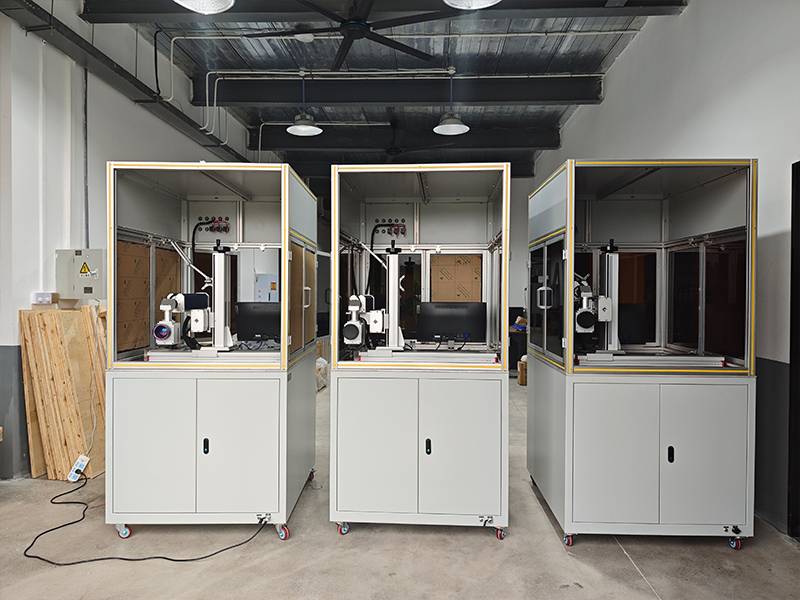
The delivered equipment was identical to the previous configuration and utilized a 100W MOPA laser, an X-axis moving module, a 90-degree steering mirror, and a semi-enclosed cabinet. The software is more complex and uses our Thorx-7 system. If you have experience with Chinese dot peen marking machines, you may be familiar with this software. Since this customer has also deployed our pneumatic dot peen markers based on this system, using the same control system minimizes staff training and increases maintenance efficiency.
The software for the automatic marking machine will connect to the customer’s existing PLC and cooperate with the robot and pneumatic fixture. After the fixture release of the workpiece, it will be moved by the module to the front of the marking machine. Then, the scanning galvo will be moved to the corresponding workpiece marking position on the X-axis. Using the data provided by the PLC for the two-dimensional code, the marking machine will engrave the code on the workpiece with cross-fill black engraving and fast white scanning.
Afterwards, the marking machine will reset to standby, and the moving module will push the workpiece to the next process, which includes scanning the QR code, grading the QR code, and entering the data into the customer’s MES system. The first sample machine marked several hundred QR codes, all of which received an A grade.
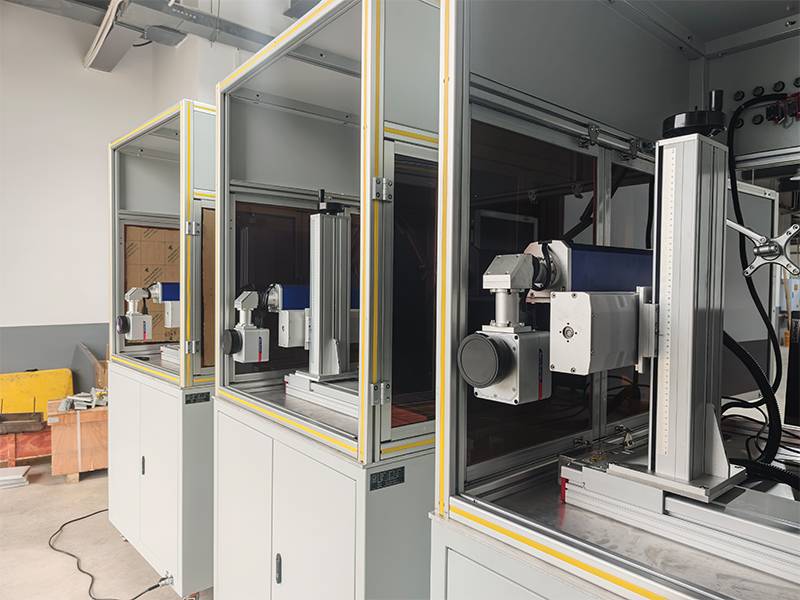
Because the machine and production line are highly automated, only technical engineers regularly patrol the line to check the condition of the equipment. We installed laser-proof acrylic panels on all three of the machine’s windows so technicians can quickly check the nodes without wearing protective glasses.
Application Context for A satisfied customer placed a reorder for the customized, automated, in-line laser marking machine
Permanent metal marking applications need the right balance between marking depth, noise, cycle time and part geometry. Dot peen, scribe and custom rotary marking systems can solve different traceability requirements depending on the workpiece.
Recommended CNMarking Solutions and Internal Resources
If you are comparing equipment for a similar application, the following CNMarking pages are useful next steps:
- Dot Peen vs Laser Marking Guide – compare permanent marking methods for metal parts.
- Portable VIN Marking Machine for Chassis and Engine Codes – choose handheld dot peen marking for vehicle traceability.
- Handheld Scribe Marking Machine – review a low-noise scribing option for metal parts.
- Benchtop Flange Engraving Machine – see a flange and heavy-part marking configuration.
How to Choose a Similar Marking Setup
Before selecting a machine, prepare a short sample brief with the following information. This helps CNMarking recommend the right laser, dot peen, scribe or automation configuration instead of only matching a picture.
- Part material, hardness and marking depth
- Flat, curved, long or irregular workpiece shape
- Manual station, benchtop fixture or automated production line
- Code type such as VIN, serial number, Data Matrix or logo
Related Reading
- Portable VIN Marking Machine for Chassis and Engine Codes
- Handheld Scribe Marking Machine
- Benchtop Flange Engraving Machine
- Custom Rotary Dot Peen Marking Machine for Oil Drilling Rods and Bits
FAQ
Can CNMarking test my own samples before I choose a machine?
Yes. For most marking, cleaning and welding projects, sample testing is the fastest way to confirm contrast, depth, speed and fixture requirements before final configuration.
What information should I send for a quotation?
Please send the material, part size, marking or cleaning area, required result, production volume and any automation or traceability requirements. Photos or short videos of the current process are also helpful.