
CNC Platform Laser Cleaning System 100-1000W, 1200×1200 mm
A 1200 x 1200 mm table on a dual-drive gantry, 3-axis standard with 5 or 6 axes optional, a 100-1000 W water-cooled JPT source, above 30 m2/h, Sa2.5/Sa3, and 0.01 mm repeat accuracy. The program holds the parameters, so one button gives the same part again.
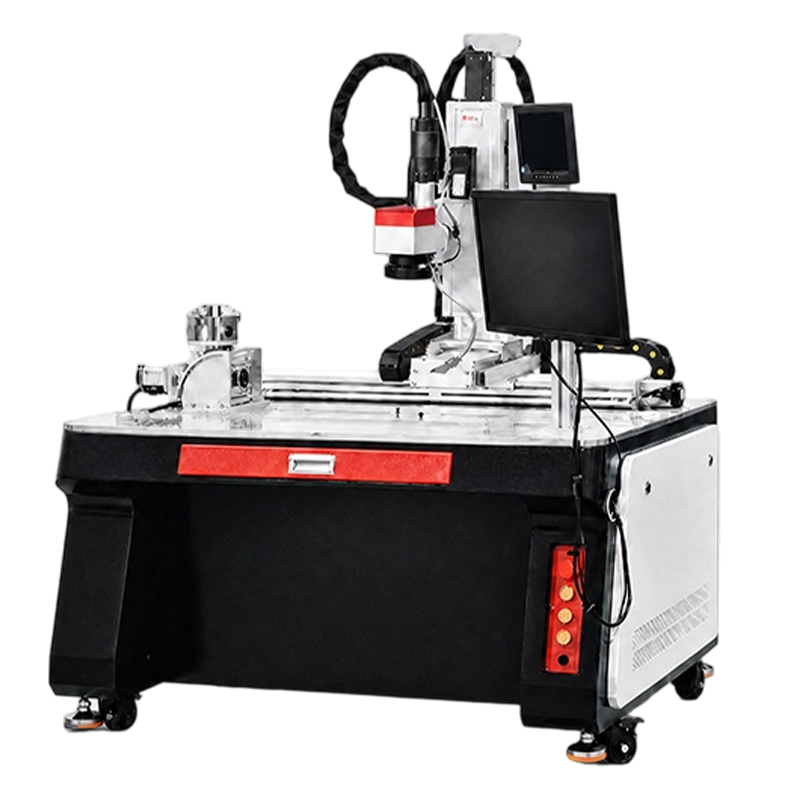
A customizable 1200 × 1200 mm working area with an F300 lens (300 × 300 mm per scan) and 15–25 mm depth of focus. Dual-drive gantry with precision linear guides and servo motors ensures stable, efficient large-area cleaning.
3-axis standard configuration for flat surfaces, rust removal and paint stripping. Optional 5- or 6-axis systems with rotary fixtures handle shafts, gears and curved surfaces, offering greater application flexibility.
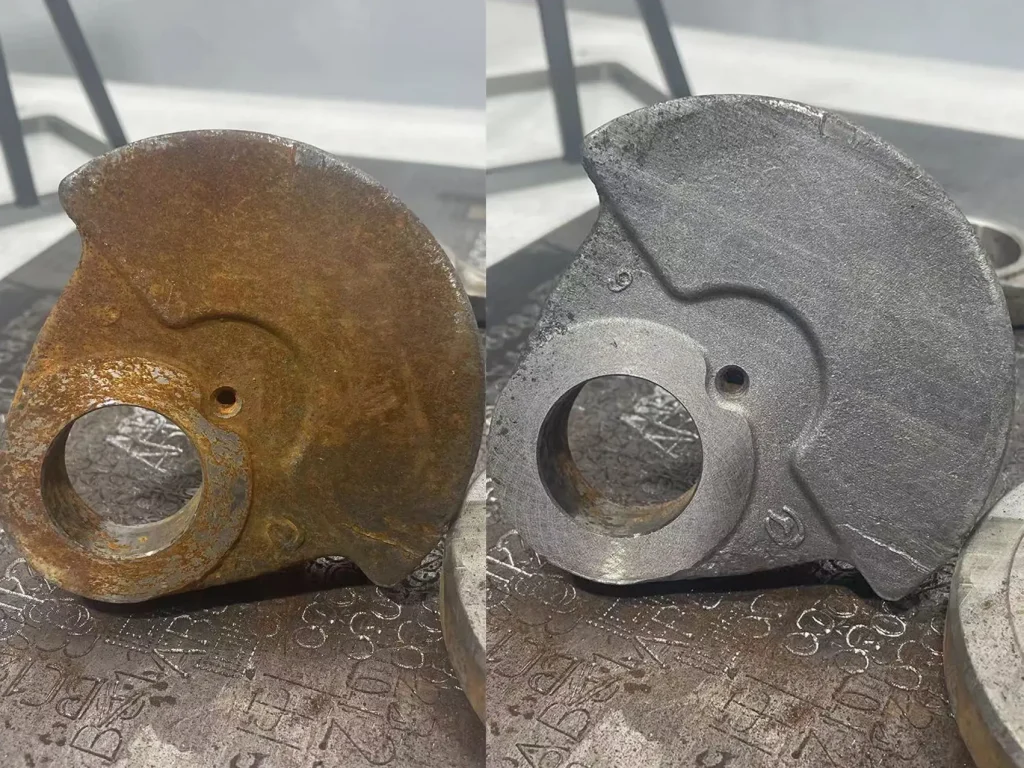
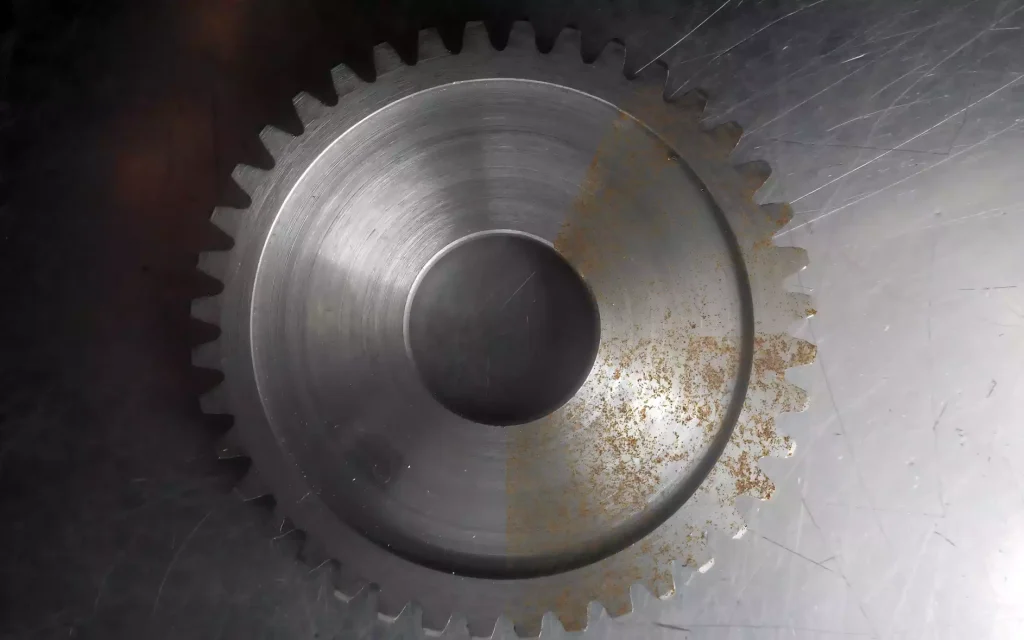
Pulsed fiber laser cleaning achieves Sa2.5–Sa3 surface cleanliness at speeds above 30 m²/h. Non-contact processing removes rust and oxide without abrasive media or chemicals, helping protect the underlying substrate.
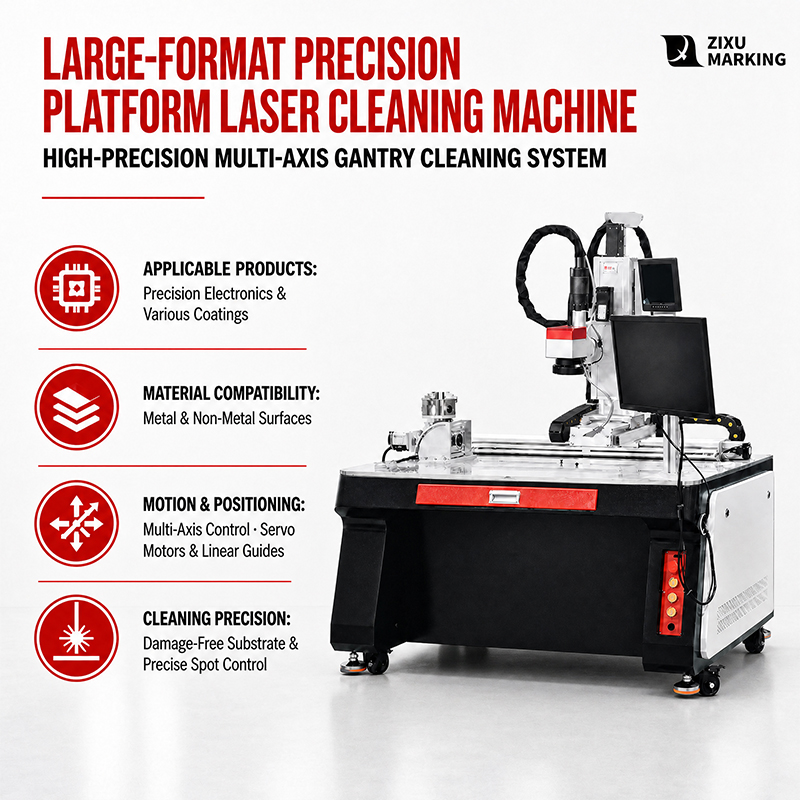

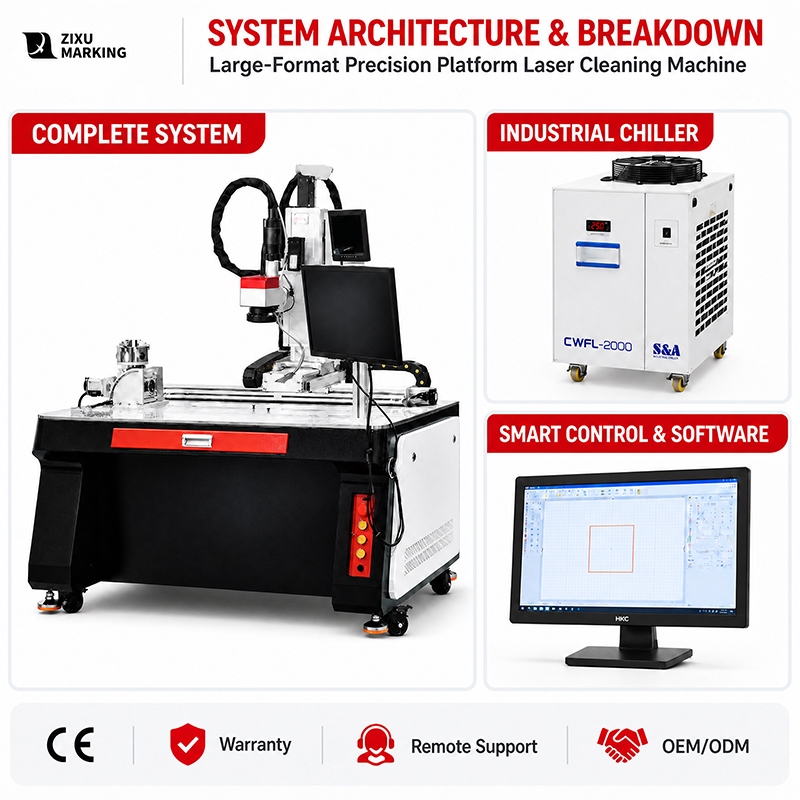

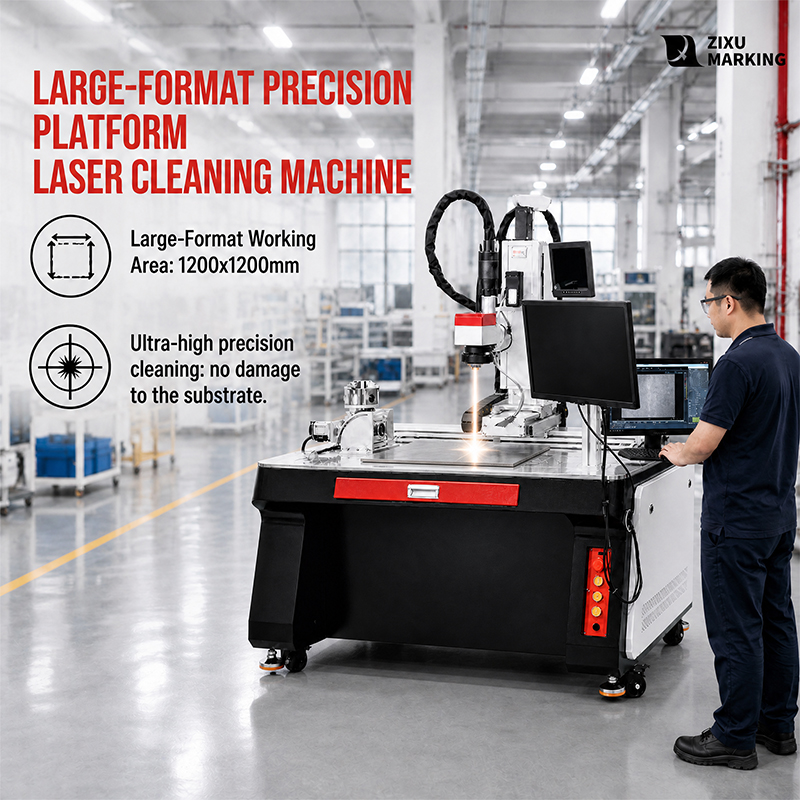

A CNC platform that turns rust removal into a process rather than a craft. The 1200 x 1200 mm table sits on a dual-drive gantry, X and Y on linear guides with Z on a ball screw, holding 0.01 mm repeat accuracy. A 100-1000 W pulsed fibre source from JPT is cooled by a water chiller so it can run continuously. An F300 lens with a 15-25 mm depth of focus scans about 300 x 300 mm per pass, and large areas are covered by stitching. Three axes are standard; add 5 or 6 axes and a rotary fixture for shafts, gears and mould cavities. Sa2.5 to Sa3 at above 30 m2/h on carbon steel, stainless, aluminium, copper, mould steel, stone and wood, entirely non-contact and chemical free. The program fixes scan speed, spot overlap and energy density, so the same file returns the same part.
| Item | Value | Note |
| Laser type | Pulsed Fiber Laser | – |
| Rated power | 100 / 200 / 250 / 300 / 500 / 1000 W | Six steps, matching the SKU |
| Central wavelength | 1080 +/- 10 nm | – |
| Pulse width | 30-500 ns, adjustable | – |
| Repetition rate | 1-4000 kHz, adjustable | – |
| Single pulse energy | 1.5 / 2 / 5 / 10 / 15 / 50 / 100 mJ | Follows the power step |
| Laser brand | JPT (standard) | The attribute reads JPT |
| Fibre length | 5 m / 10 m optional | – |
| Cleaning rate | Above 30 m2/h | The attribute reads 30 m2/h |
| Max working area | 1200 x 1200 mm, customizable | Not an attribute, see chapter 9 |
| Field lens | F300 mm, DOF 15-25 mm | About 300 x 300 mm per pass |
| Actuator | Gantry with 5- or 6-axis linkage | Wording differs from ‘3-axis standard’, see chapter 9 |
| Materials | Carbon steel, stainless, aluminium, copper, mould steel, stone, wood | The attribute adds glass, plastic, acrylic, rubber and ceramic |
| Surface grade | Sa2.5 / Sa3 | – |
| Structure | Dual-drive gantry, large format | – |
| Effective stroke X x Y x Z | Fully customizable | – |
| Repeat accuracy | 0.01 mm | – |
| Motion axes | 3 standard, 5 or 6 optional | – |
| Guide rails | HIWIN / THK / PMI | – |
| Transmission | Linear guide on X/Y, ball screw on Z | – |
| Servo system | Delta / Inovance / Panasonic / Yaskawa | – |
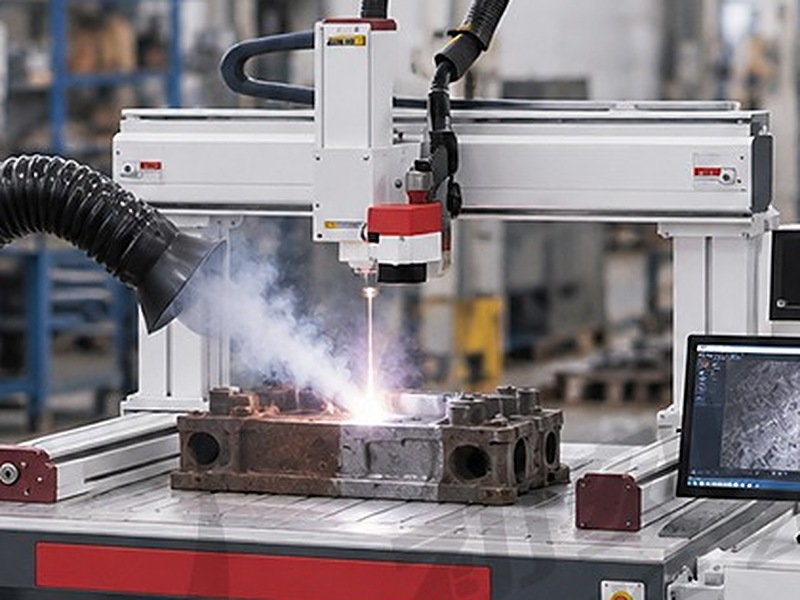
Gantry beam and linear guides: 0.01 mm comes from stiffness
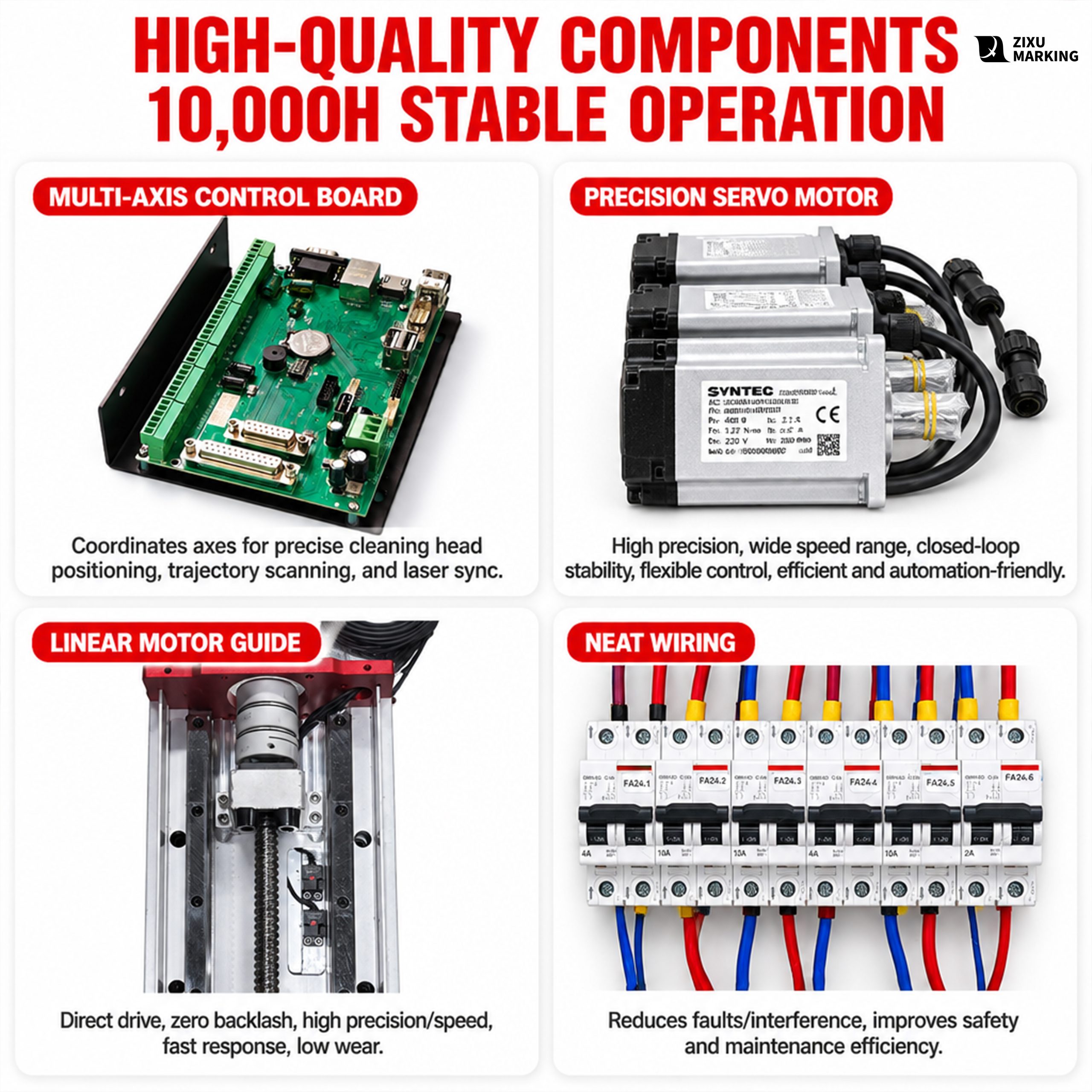
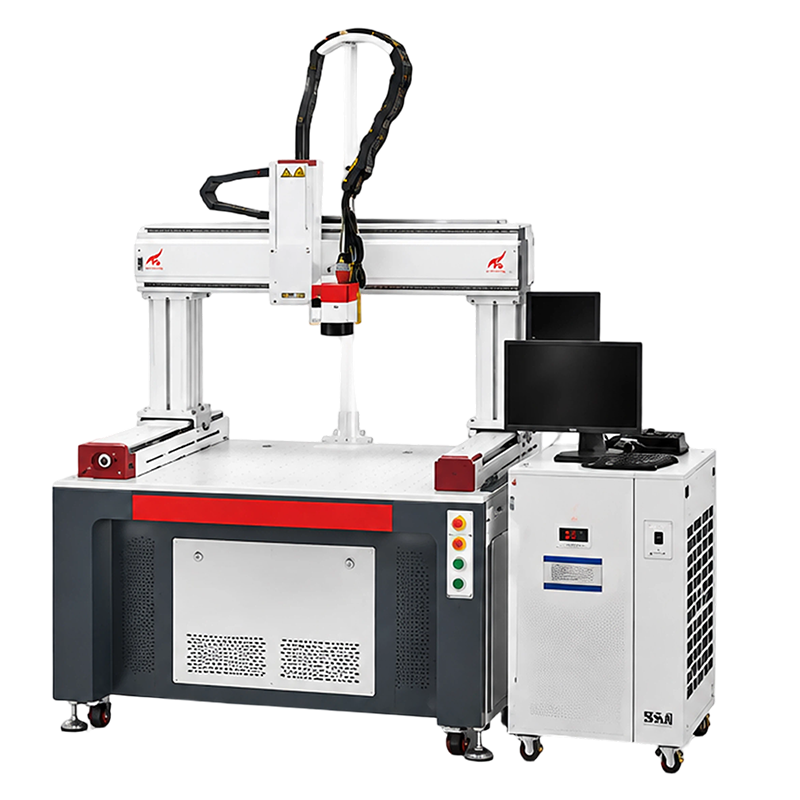
The beam is a heavy-wall aluminium extrusion carrying steel linear guides; the carriage rides the rail and the head moves only in Z. A beam that does not flex and a carriage that does not creep is what holds 0.01 mm repeat accuracy. Guides are HIWIN, THK or PMI, Z runs on a ball screw, and the servos are Delta, Inovance, Panasonic or Yaskawa – part numbers you can read on the drawing and buy anywhere.
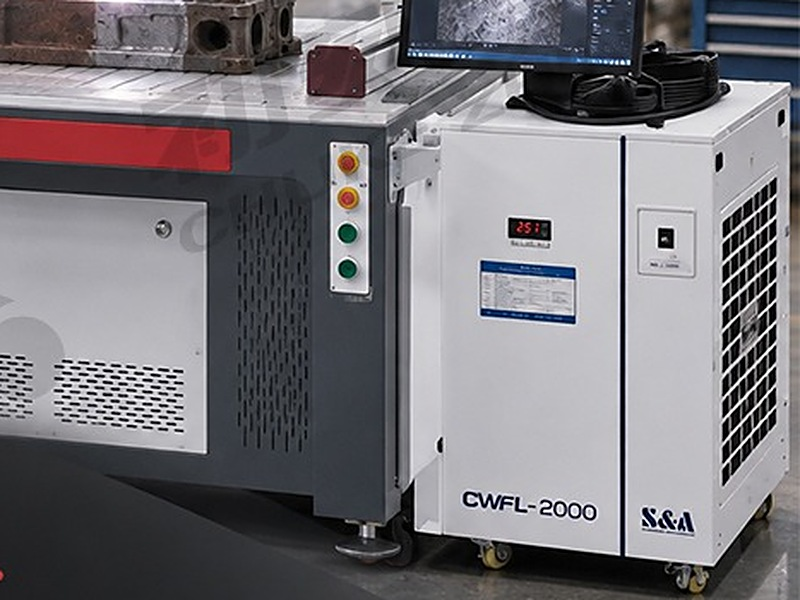
CWFL-2000 chiller: a full shift without derating
On the right sits an S&A CWFL-2000 chiller with a digital temperature display and hoses running to the head. It carries away the heat of the 100-1000 W pulsed source, so the machine holds its takt all day without buying stability by cutting the repetition rate. The chiller is a separate caster-mounted cabinet: servicing or moving it never disturbs the machine.
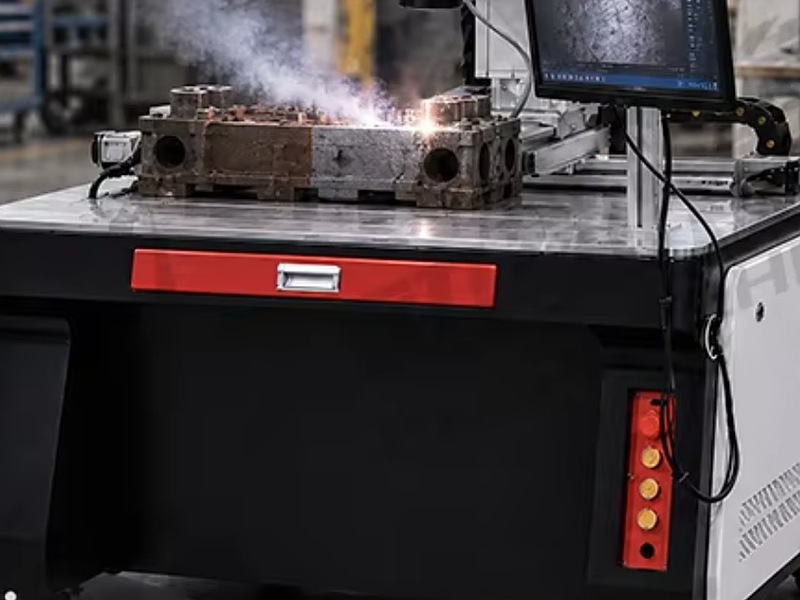
A 1200 x 1200 mm table: the whole casting goes on
A 1200 x 1200 mm table, available larger, taking a cast block in one piece – nothing has to be broken down. The F300 lens covers about 300 x 300 mm per pass with a 15-25 mm depth of focus, and the gantry stitches the passes across the whole table; table flatness and stroke decide whether the seams show.
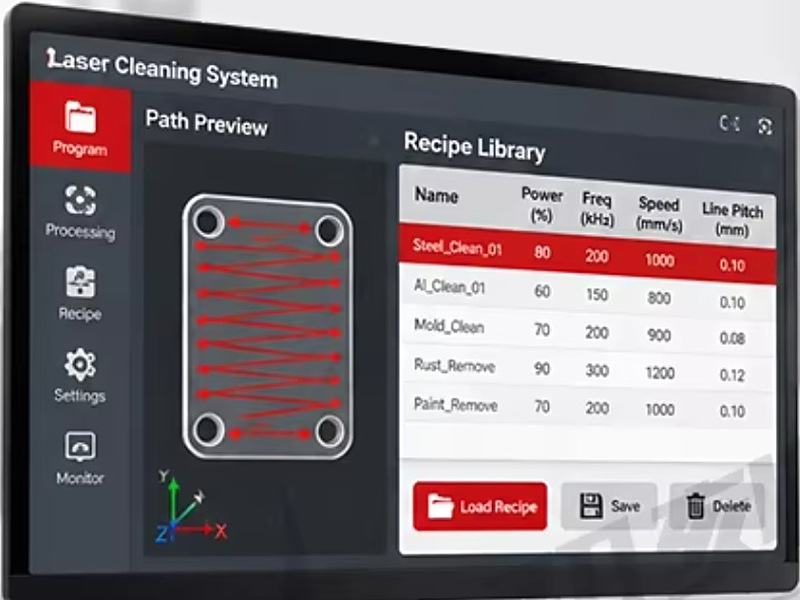
Recipe library and path preview: a different operator, the same part
Every process is stored as a recipe: power percentage, frequency, scan speed and line pitch, with separate entries for steel, aluminium, mould, rust removal and paint removal. The path can be drawn, taught or imported as DXF or Step. A new operator loads the recipe and presses start, and the part matches the one the veteran ran.
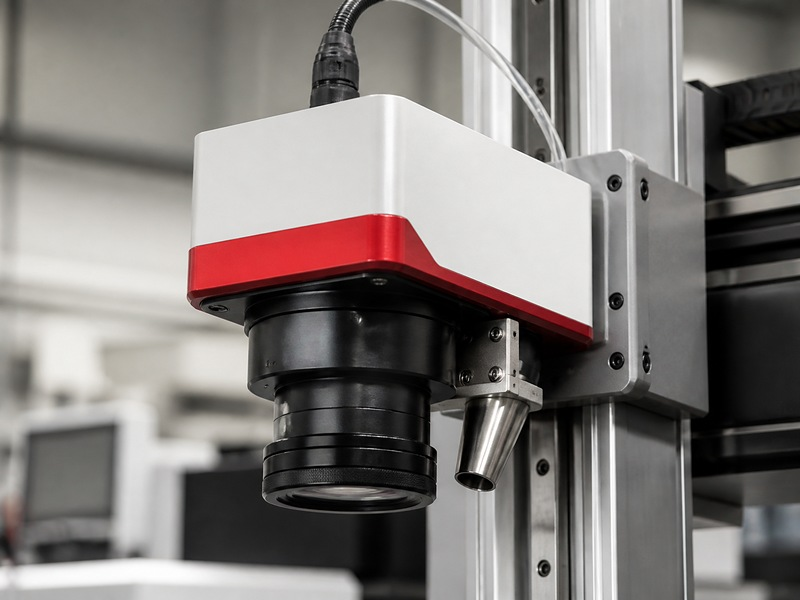
Head and F300 lens: 300 x 300 mm per pass, 15-25 mm depth of focus
The head is a white housing with a red bezel, a black F-theta barrel below it ending in a protective-window ring, and an air knife at the side to blow smoke clear. Barrel and nozzle sit on the same carriage, so a window change needs no re-alignment; the protective window is the only optical part that wears, and it comes out with the ring.
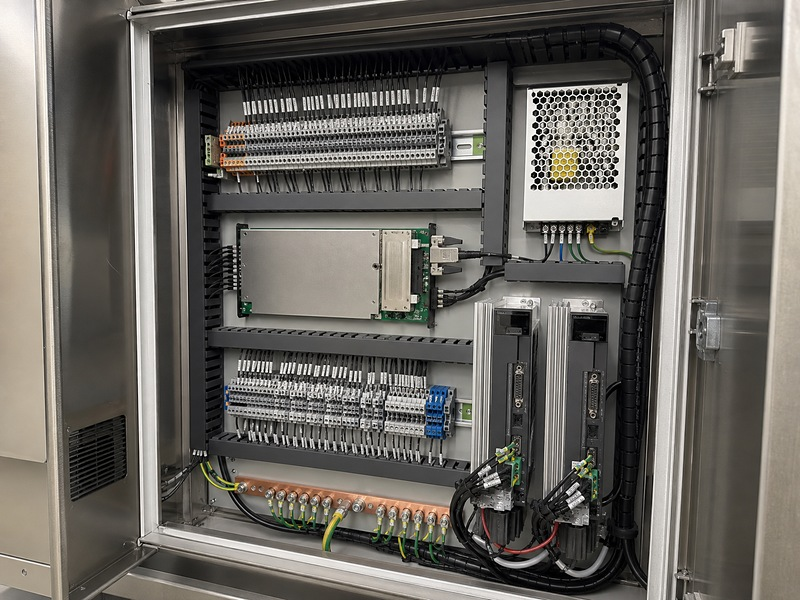
Cabinet interior: numbered wires, model-numbered parts
The panel follows standard build practice: terminal blocks with white ferrule sleeves, bundles in ducts with the lids closed, the control card in its own shielded slot, the power supply and two servo drives on their own rails, and a copper earth bar along the bottom taking the green-and-yellow wires. A fault can be traced from the drawing instead of from a tangle.
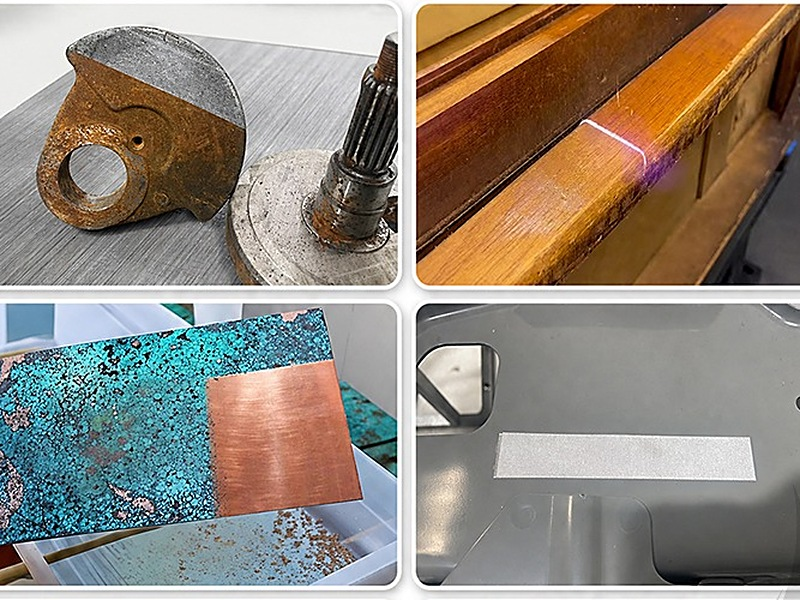
Results: four substrates, one boundary
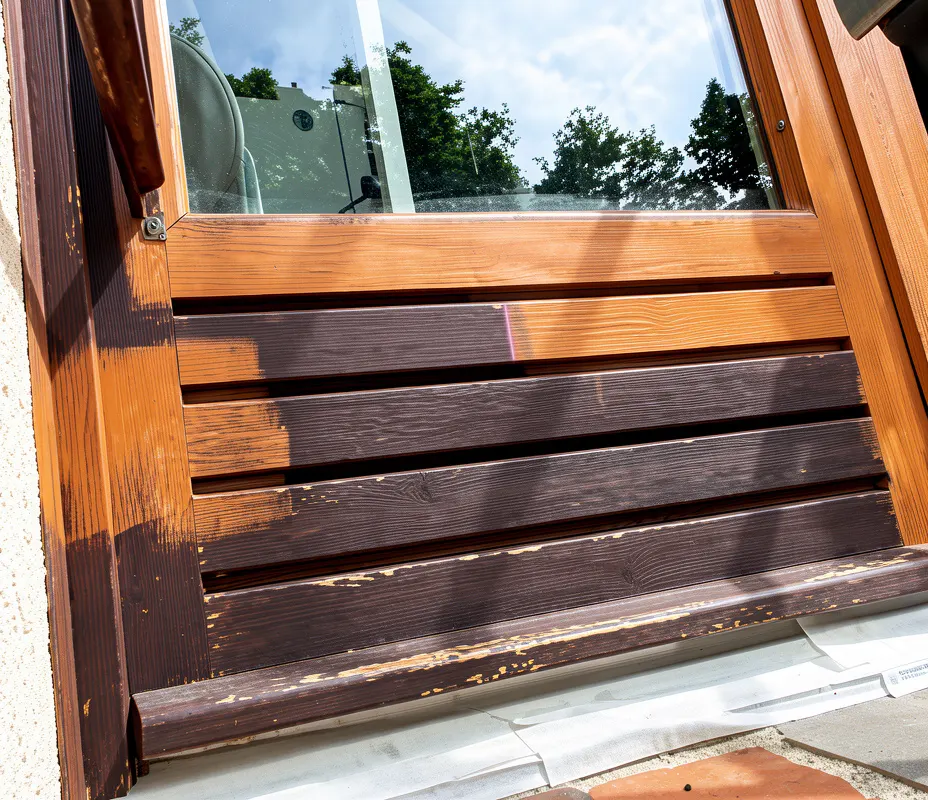
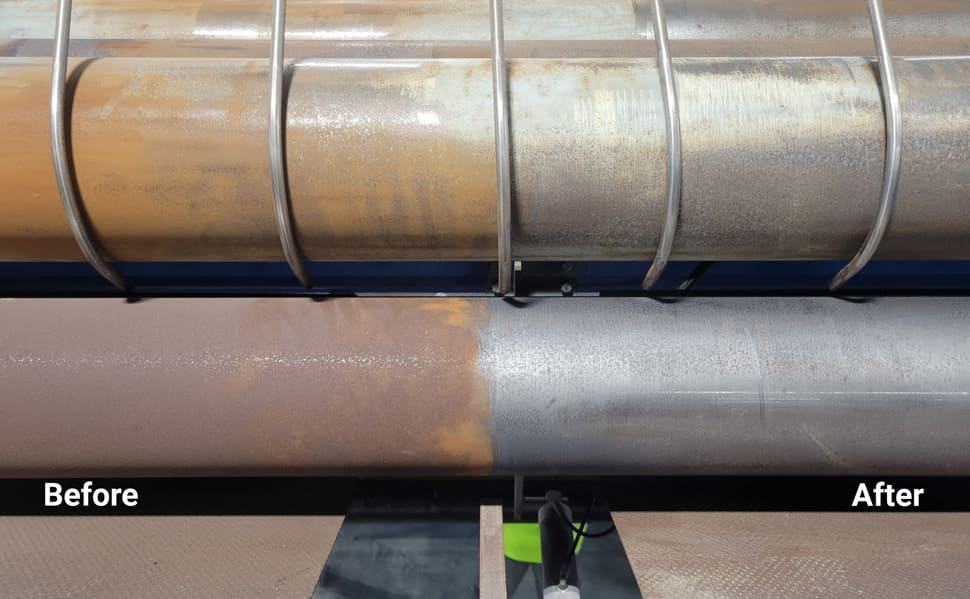
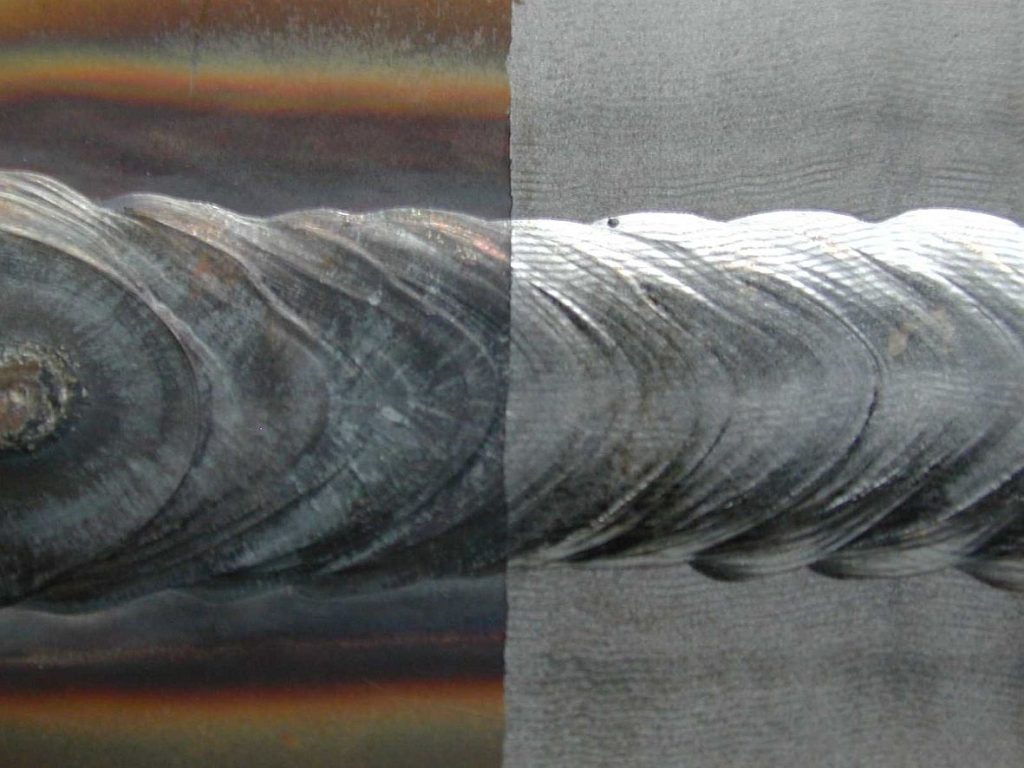
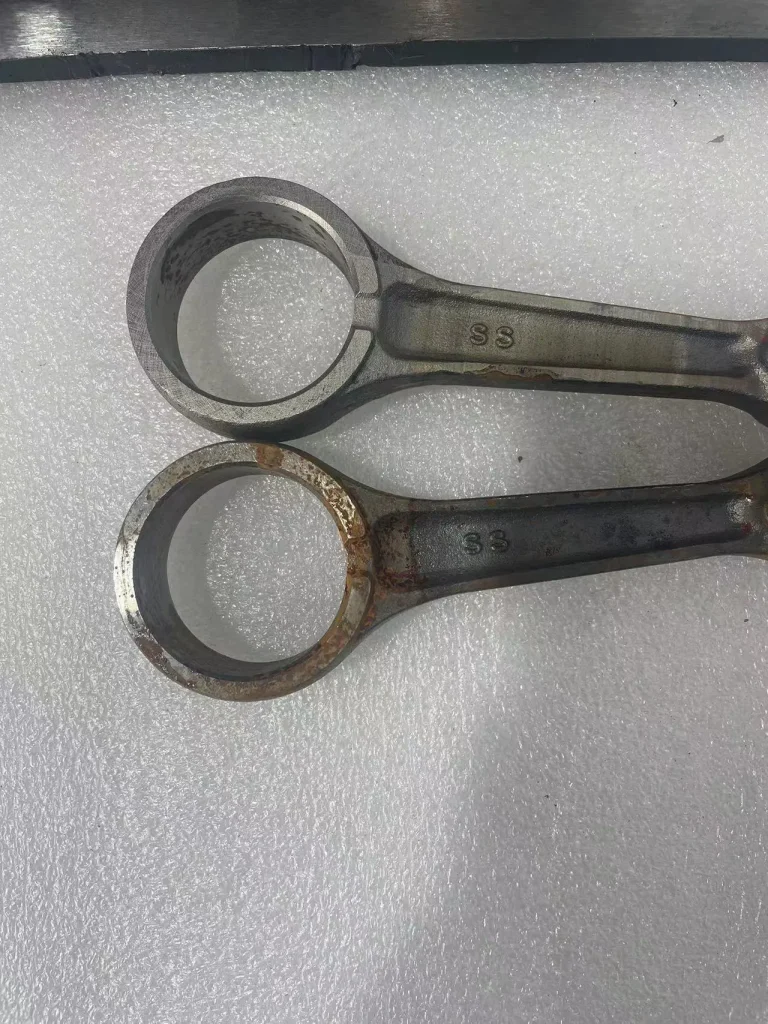
A rusted casting, painted timber, oxidised copper and a painted steel plate – four substrates off the same machine. The boundary stops where the program says: the cleaned area shows bare metal, the rest is untouched. An edge that clean comes from the file, not from a steady hand.
| Item | Detail |
| Documents | Packing list, CE certificate, program template and manual |
| Installation | Gantry ships in sections; on-site assembly, levelling, alignment and first-article run |
| Training | One to two days on site: programming, parameter library, routine care |
| Site requirements | 380 V three-phase, dry air or an on-site compressor, and an extraction connection |
Materials and processes
| Material | Process | Configuration | Result | Watch |
| Carbon and structural steel | Rust, paint, weld preparation | Above 30 m2/h | Sa2.5 / Sa3 | Full-sheet stitching |
| Stainless steel | Weld discolouration, scale, post-weld cleaning | Programmed along the seam | Bright metal finish | Seam following |
| Aluminium | Oxide, release agent, pre-weld degreasing | 100-300 W range | No substrate damage | Thin sheet stays flat |
| Copper and brass | Oxide, flux residue | Low power, high frequency | Bright metal | High conductivity, watch the energy |
| Mould steel | Carbon build-up, release agent, cavity oxide | Follows the form, 5 or 6 axes | Texture untouched | Cavities and parting lines |
| Stone and wood | Surface soiling, old coatings | Low power, wide overlap | Texture preserved | Non-metal substrates |
| Glass, ceramic, plastics | Coatings, ink, mould marks | Lowest power step, parameters first | No cracking or melting | Parameters confirmed before the run |
Laser Cleaning Samples
Send us an email to get further information you need, including our latest price, the best-customized solution, or any problem with the existing machine.