
Automotive & Motorcycle Mold Relief Marking: Layered Engraving Solution Contract Signed
Customer Requirements
An automotive & motorcycle mold manufacturing customer visited our facility for inspection and sample testing. Their core requirements are as follows:
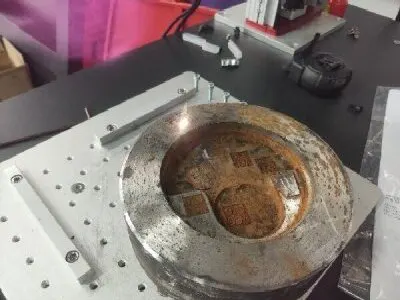
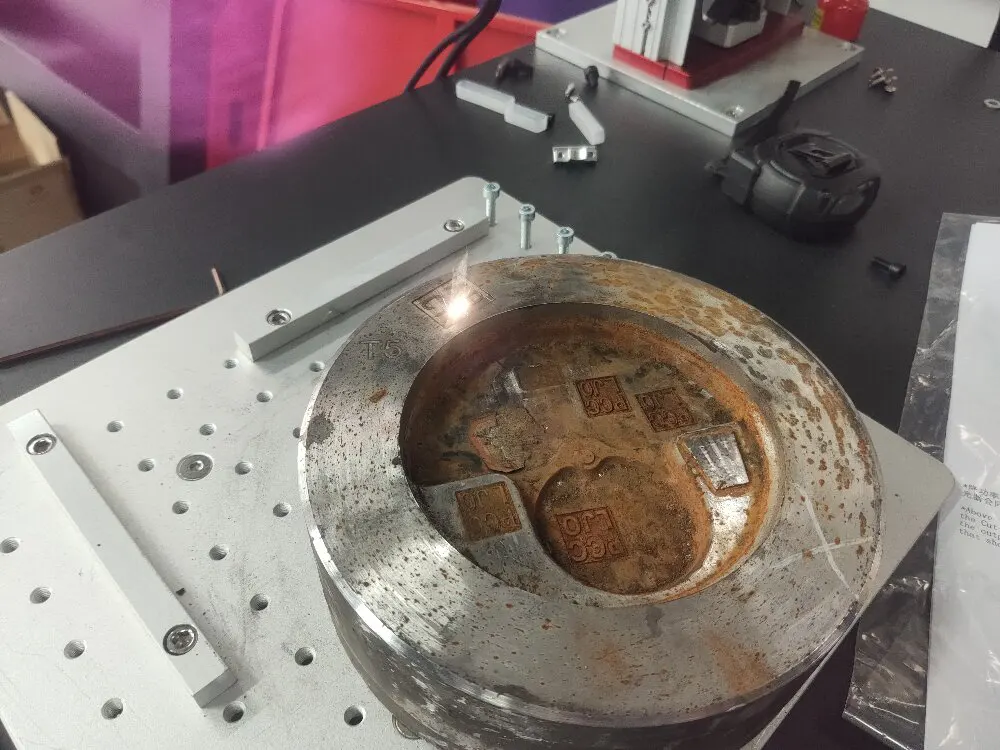
The customer needs to use an engraving machine on casting molds that are divided into left and right halves. They require independent serial numbers in relief effect to be marked at corresponding positions on both molds, with character height controlled between 50–80 filaments (0.5–0.8mm). The serial numbers at corresponding positions on the left and right molds must be consistent or paired/associated. Acceptable relief processing efficiency must be achieved on steel molds to support subsequent batch production rhythms. The relief must have clear edges, no chipping, and consistent depth, with good usability and readability.
Solution
To address the challenge of achieving 0.5–0.8mm relief depth on steel molds, we built a functional prototype. The core configuration of this marking machine is as follows:
Laser Source
Equipped with a 300W JPT M7 laser, delivering high-power, high-beam-quality output for efficient steel ablation.
Galvanometer Scanner
Paired with a ZBTK high-performance water-cooled galvanometer to ensure thermal stability and positioning accuracy during prolonged, deep-processing operations.
Control Card
Adopts a BSL deep-engraving control card, combined with a Z-axis servo motor, to achieve dynamic downward movement of the optical path.
Core Process Software
Uses RZ-CAD software to automatically divide the graphic to be engraved into hundreds or even thousands of processing layers.
Z-Axis Follow-Up Focusing Technology
After engraving a certain number of layers, the software automatically controls the servo motor to drive the optical path downward by a set distance, ensuring the processing surface always remains at the focal point of the laser energy — this is the key to achieving relief depths of over 0.5mm while maintaining both efficiency and quality.
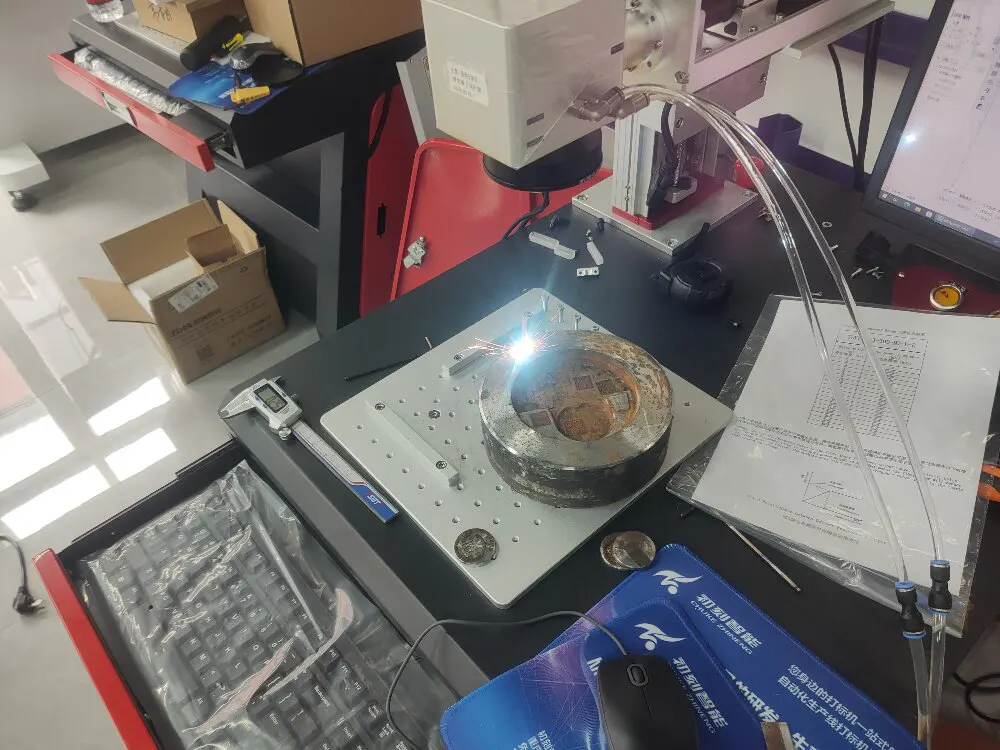
To simulate a real production environment, a temporary functional prototype was used for this sample testing. For actual delivery, the equipment will be upgraded to an enclosed cabinet and integrated with two auxiliary systems:
Air Blow System: Blows away floating metal particles and debris on the workpiece surface, maintaining direct contact between the laser and the processing surface, and avoiding plasma shielding effects.
Fume Extraction System: Extracts metal fumes and dust generated during processing through a fume extractor, preventing workshop environmental pollution and safeguarding operator health.
Customer Feedback: “Many suppliers can do 50-filament steel relief, but few can achieve stable coordination between Z-axis dynamic layering and the galvanometer.”
Achieved Results: On the steel mold samples brought by the customer, a relief depth of 0.5mm was successfully processed, with clear characters, strong three-dimensional effect, and accurate matching of corresponding positions on the left and right molds.
Acceptable Efficiency: The current single processing time for 0.5mm relief is approximately 12 minutes, which the customer confirmed meets expectations. After the subsequent installation of the air blow system, it is expected to be reduced to under 10 minutes, improving efficiency by approximately 17%.
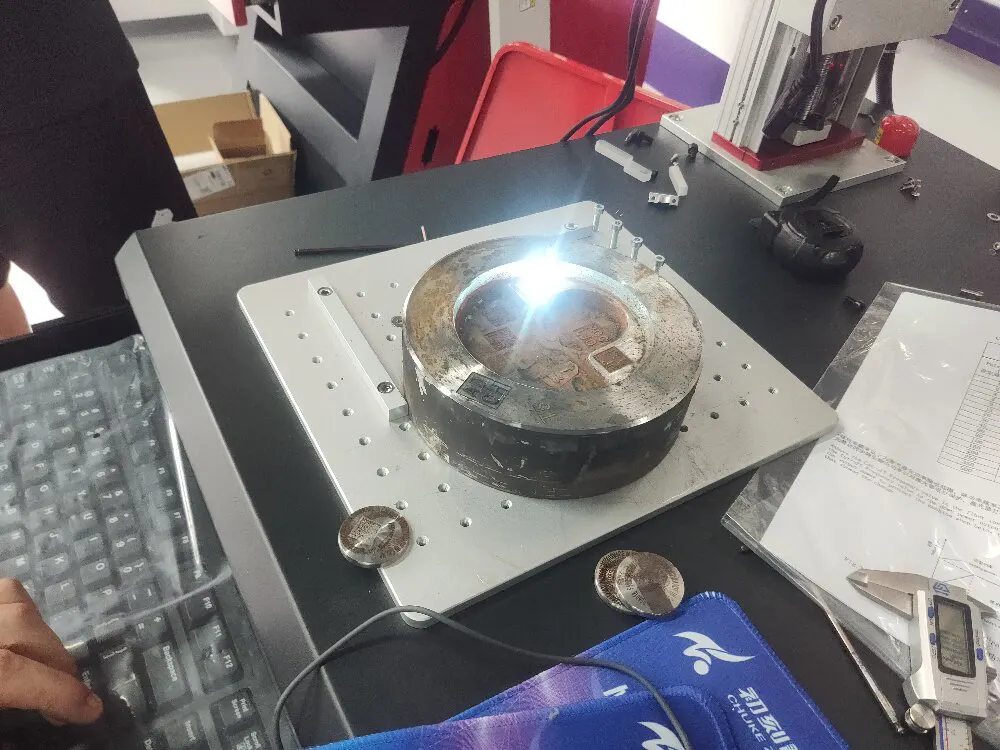
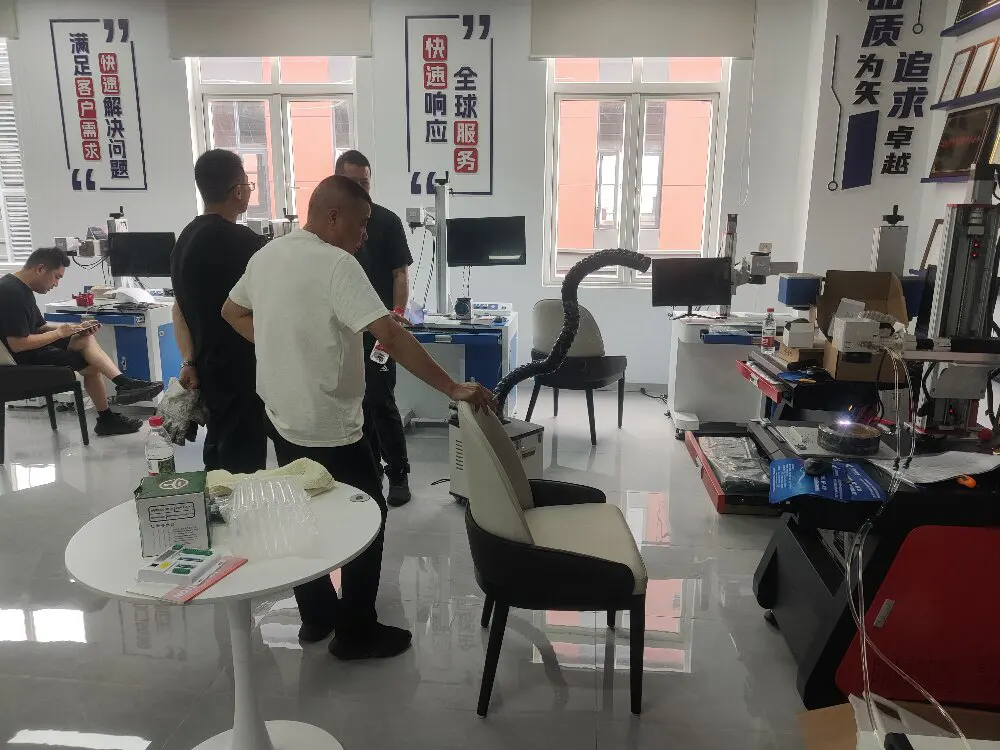
Cooperation Confirmed: After completing the sample test, the customer immediately confirmed the technical solution was feasible and formally signed the contract, converting the intent into an order.
This automotive & motorcycle casting mold relief marking project, from customer on-site sample testing to contract signing, has validated a clear path: even for achieving relief serial numbers of over 0.5mm on steel molds, it can be completed within 12 minutes, with confidence to optimize it to under 10 minutes.
The key lies not simply in increasing laser power, but in a systematic design that combines layered engraving + Z-axis follow-up focusing + high-performance water-cooled galvanometer + enclosed fume extraction — ensuring every layer of energy lands precisely on the focal point. This layered engraving approach shares the same principle as laser internal engraving machines that form images layer by layer inside transparent materials — the only difference being that one carves “inward” into the material, while the other “floats” outward from within.If your industry also involves mold steel, mechanical parts, relief QR codes, deep serial numbers, or brand logos, you are welcome to bring your samples for testing. What we provide is not just a laser machine, but a deliverable, mass-production-ready, contract-ready deep engraving solution.